Category Archives: Research

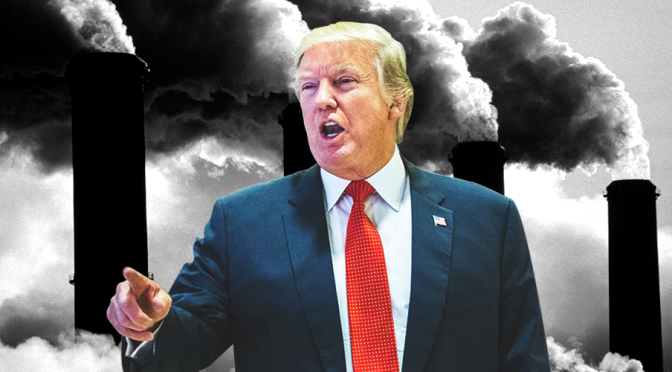
What if? Trump’s environmental legacy in 2019

Shortly after the election of Donald J. Trump as 45th President of the United States in November last year, Jane Lê and I were asked by the University of Sydney Business School to imagine what the US would look like in 2019, two years into the new Presidency. So we cast caution to the wind and decided to record a ‘What If’ podcast imagining what Jan 2019 might look like in the US with respect to the environment, energy and climate change.

Continue reading What if? Trump’s environmental legacy in 2019

Call for Papers: ‘Organizing and the Anthropocene’

The following is a Call for Papers for a Special Issue of the academic journal Organization. Full paper submission deadline is 28th February 2017.

‘Human activities have become so pervasive and profound that they rival the great forces of Nature’ (Steffen, et al., 2007)

Through the rapacious consumption of fossil fuels, industrial activities and the destruction of forests, oceans and natural resources, humans have fundamentally changed basic Earth systems. This has occurred at such a scale and pace that Earth System scientists argue we are leaving the Holocene geological epoch and entering the more volatile ‘Anthropocene’. This is a period in which human activity has discernibly affected the Earth’s global functioning to such an extent it is now operating outside the range of any previous natural variability (Crutzen, 2002; Hamilton, 2015; Steffen, et al., 2007). These changes reduce the ‘safe operating space for humanity’ (Rockström, et al., 2009), and include: a likely step-change in the average temperature of the planet this century of around 4 degrees Celsius (New, et al., 2011); the sixth great species extinction in the geological record (Kolbert, 2014); the acidification of our oceans; the disruption of the nitrogen and phosphorus cycles; and the pollution of air and water with a range of chemical toxins (Whiteman, et al., 2013). Extreme weather events, sea-level rise, food and water shortages, and accompanying political conflicts and wars suggest that life this century for much of the planet’s population will be ugly, violent and precarious (Dyer, 2010). The implications for organizations and organizing could not be more profound. Continue reading Call for Papers: ‘Organizing and the Anthropocene’

Energy Security: The New Black!

As many Australian readers will know, ‘energy security’ has become the latest buzzword in government and industry circles. Much of this new focus has been driven by the political fallout following October’s catastrophic storms in South Australia and a state-wide power blackout. In the political recrimination that followed, the Federal Government and some media outlets argued that state government policies favouring renewable energy were (in part) to blame. Both the Prime Minister and the Federal Energy Minister quickly labelled energy security their ‘number one priority’ and established an energy security review to be chaired by the nations’ Chief Scientist, Alan Finkel. Interestingly however, the meaning of the term ‘energy security’ is itself open to multiple interpretations. To a large extent this ‘framing’ of ‘energy security’ reflects a number of developments that are playing out globally in the areas of energy and environmental policy. Continue reading Energy Security: The New Black!

Capital & Class Review of Climate Change, Capitalism and Corporations

Book Review: Climate Change, Capitalism, and Corporations. Processes of Creative Self-Destruction by Christopher Wright and Daniel Nyberg, Capital & Class, 40(2), pp.394-396, doi:10.1177/0309816816661148n

Marc Hudson, Sustainable Consumption Institute, University of Manchester.

In December 2015 world leaders gathered to proclaim climate change was a threat that they were (finally) going to do something about. After two weeks of speeches and haggling, the deal was done, the world saved. Never mind that the text was silent on fossil fuels, and that in the following week the UK government expanded fracking, the US rescinded a forty year old ban on oil exports and Australia gave new permits for coal mines. Those are minor pesky details; corporate capitalism has the best interests of everyone – rich, poor, black, white, the unborn generations to come, other species – at heart. Continue reading Capital & Class Review of Climate Change, Capitalism and Corporations

Recent Commentary on Climate Change, Capitalism and Corporations

Our new book Climate Change, Capitalism and Corporations: Processes of Creative Self-Destruction has been a feature of a number of recent analyses of the climate crisis.

For instance, world-renowned ecologists Anne and Paul Ehrlich recently wrote an article entitled “Faith-Based Economics: The Corporate World and the Survival of Civilization” which critiqued business assumptions of economic growth and neglect of environmental limits. Here they noted:

Corporations are the most organized segment of society that actually believes the message of faith-based economics, although cracks have appeared in the façade. For example two business professors, Christopher Wright and Daniel Nyberg, have just published a book, (Climate Change, Capitalism, and Corporations: Processes of Creative Self-Destruction) that provides a detailed and well-documented account of how corporations are destroying civilization by keeping that faith: the standard business-school/Wall Street message that climate disruption, a result of market success in turning natural resources into stuff and waste, can only be cured by business as usual. Faith-based economics requires continued exploitation of natural resources and continued growth of the global economy. As Wright and Nyberg say:

“…corporate capitalism frames business and markets as the only means of dealing with the crisis, rejecting the need for state regulation and more local democratic options. In essence, the prevailing corporate view is that capitalism should be seen not as a cause of climate change but as an answer to it. A problem brought about by overconsumption, the logic goes, should be addressed through more consumption.”

As Clive Hamilton put it in the introduction to the book, “The hard truth is that these corporations would sooner see the world destroyed than relinquish their power.” Continue reading Recent Commentary on Climate Change, Capitalism and Corporations

Challenging ‘Fossil Fuels Forever’

There is a disconnect between ever more alarming scientific projections of anthropogenic climate disruption and the contrasting conservatism of mainstream ‘business as usual’ political discourse. This wholly irrational future is the focus of our new book Climate Change, Capitalism and Corporations: Processes of Creative Self-Destruction (Cambridge University Press, 2015). It is a disjuncture that makes imagining economic, let alone social or environmental futures a somewhat bizarre enterprise. Nevertheless, let’s consider the conventional view of our future world as presented by mainstream business and political commentators. Continue reading Challenging ‘Fossil Fuels Forever’

Corporations and climate change

Global businesses, many of them now larger and more powerful than nation states, exhibit enormous sway on humanity’s response to the climate crisis. Indeed, in the lead-up to the Paris climate talks later this month there is growing media focus on so-called business “leadership” on climate change. For instance, just last month Royal Dutch Shell, General Electric, BHP Billiton and management consultancy McKinsey & Co. announced the establishment of a committee to advise governments on how to combat global warming while strengthening economic growth. This follows other announcements such as Unilever’s chief executive officer, Paul Polman, emphasising the need for private sector mobilization to close the shortfall in emission commitments made by governments, as well as Virgin’s CEO Richard Branson who has argued that “our only hope to stop climate change is for industry to make money from it.” Continue reading Corporations and climate change

Explaining Creative Self-Destruction and the Climate Crisis

Recently, Daniel Nyberg and I did an interview with Catherine Zengerer on radio station 2SER’s “On the Money” show about our new book Climate Change, Capitalism and Corporations: Processes of Creative Self-Destruction.

The interview is a good outline of many of the core arguments in our book. As the summary accompanying the interview outlines:

With climate change an impending reality it seems the world has a problem with overconsumption. But according to two business professors we are failing to address the very cause of climate change – capitalism.

Neoliberal economists argue that climate change – a market problem, is addressed by a market solution. But according to Professor Christopher Wright and Professor Daniel Nyberg more consumption is not the solution in a society where the environmental model is often traded off for a business model. Can we have our cake and eat it too?

You can hear the full interview (about 10 minutes) here.


Panel Discussion on Climate Change, Capitalism and Corporations

Bill McKibben has argued that “it’s possible that there’s no greater example of corporate irresponsibility than climate change – I mean, these companies melted the Arctic, and then rushed to drill in the open water. ”

With the recent revelations that oil giant Exxon has known about the likely catastrophic impacts of continued fossil fuel use as far back as 1981, it seems McKibben is spot on in his assessment. After all what could be more immoral and irresponsible than knowingly destroying the habitable climate of the only home we have – planet Earth! Continue reading Panel Discussion on Climate Change, Capitalism and Corporations

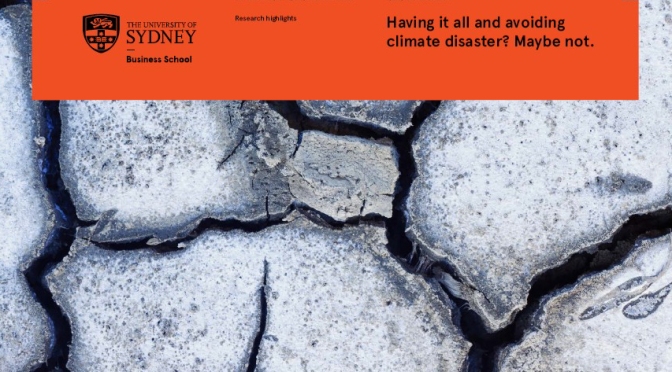
Having it All and Avoiding Climate Disaster? Maybe Not

The University of Sydney Business School recently featured the new book that Daniel Nyberg and I have authored Climate Change, Capitalism and Corporations: Processes of Creative Self-destruction as part of their Research Highlights series. The book is presented as “a sobering yet hopeful account of how corporate myths have slowed our response to human-caused climate change, and what we can do about it.” You can view the PDF of the story here and the video is below.


Creative Self-Destruction and the Climate

Leading public intellectual and Professor of Public Ethics at Charles Sturt University, Clive Hamilton very generously wrote the excellent Foreword to our new book Climate Change, Capitalism and Corporations: processes of Creative Destruction.  Below is an adapted version of that Foreword recently published in The Conversation.

——-

In his 2006 landmark report on how we should respond to the climate crisis, Nicholas Stern characterised global warming as an ‘externality’, a damage to others due to market activity whose cost is not met by those who cause it. Continue reading Creative Self-Destruction and the Climate

New book on Climate Change, Capitalism and Corporations

Our new book Climate Change, Capitalism, and Corporations: Processes of Creative Self-Destruction has just been published. Based on research that Daniel Nyberg and I have been conducting over the last 6 years, the book explores the complex relationship that the corporate world has with climate change and the central role corporations play in shaping political and social responses to the climate crisis.

In the book, we explore the different processes through which corporations engage with climate change. The principal message is that despite the need for dramatic economic and political change, corporate capitalism continues to rely on the maintenance of ‘business as usual’. As outlined in this short summary in The Conversation this involves the myth that ‘green’ capitalism is a viable response to the climate crisis. This response enables the incorporation of critique and the maintenance of corporate capitalism despite the dire environmental consequences. Continue reading New book on Climate Change, Capitalism and Corporations

Using social media to turbo-charge your research!

Recently I helped organise a social media training event at my university. The idea was to expose academics to different social media platforms, highlight the advantages of social media for academic work, and also teach them the basics of blogging and Twitter. Afterwards I was interviewed about how and why I use social media in my climate change research. Having been seduced by the attractions of social media some years ago, I’m now very much a social media advocate. Anyway, here’s my response to some of the interview questions re my own social media use:

Continue reading Using social media to turbo-charge your research!

Representing Climate Change?

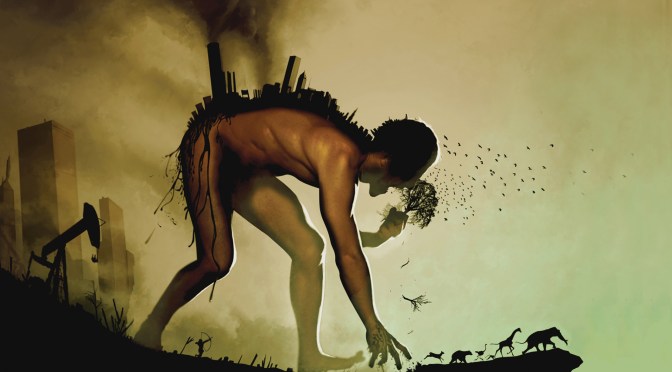
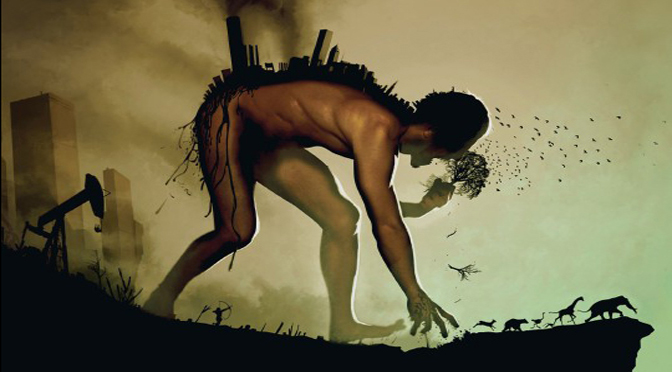
Writing about climate change often requires some type of visual reference particularly given the way our eyes are drawn to the visual in social media settings and more generally in public debate. But how do you visually represent the human-induced climate disruption we are now living through? As Naomi Klein has demonstrated so powerfully, climate change ‘changes everything’! And yet despite its profound impacts, it is a phenomenon that is also diffuse across space and time.

This was an issue that I confronted late last year when Daniel Nyberg and I completed the manuscript for our forthcoming book Climate Change, Capitalism and Corporations: Processes of Creative Self-Destruction. With the draft manuscript sent off to the publishers, we then agonised over the book cover design. An early offer from the publishers presented a somewhat anodyne image of suited business people on an  escalator (the sort of thing one sees everyday on management textbook covers) – probably relevant in that context but nothing really about climate change. Continue reading Representing Climate Change?

Climate Change, Capitalism and Corporations out in September

Our new book Climate Change, Capitalism, and Corporations: Processes of Creative Self-Destruction will be released in both paperback and hardback in late September. You can view the website for the book here.

Based on research that Daniel Nyberg and I have been conducting over the last 6 years, the book explores the complex relationship that the corporate world has with climate change and examines the central role of corporations in shaping political and social responses to the climate crisis. Continue reading Climate Change, Capitalism and Corporations out in September