
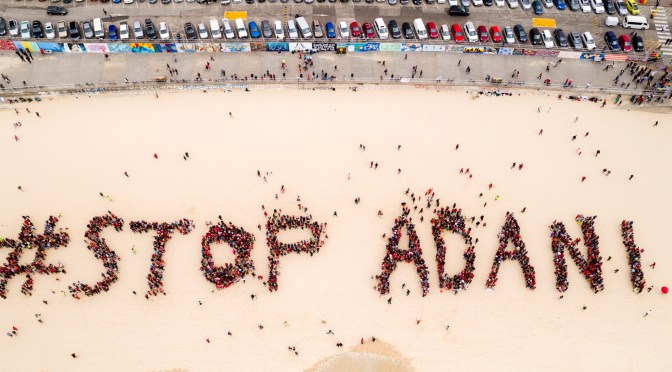
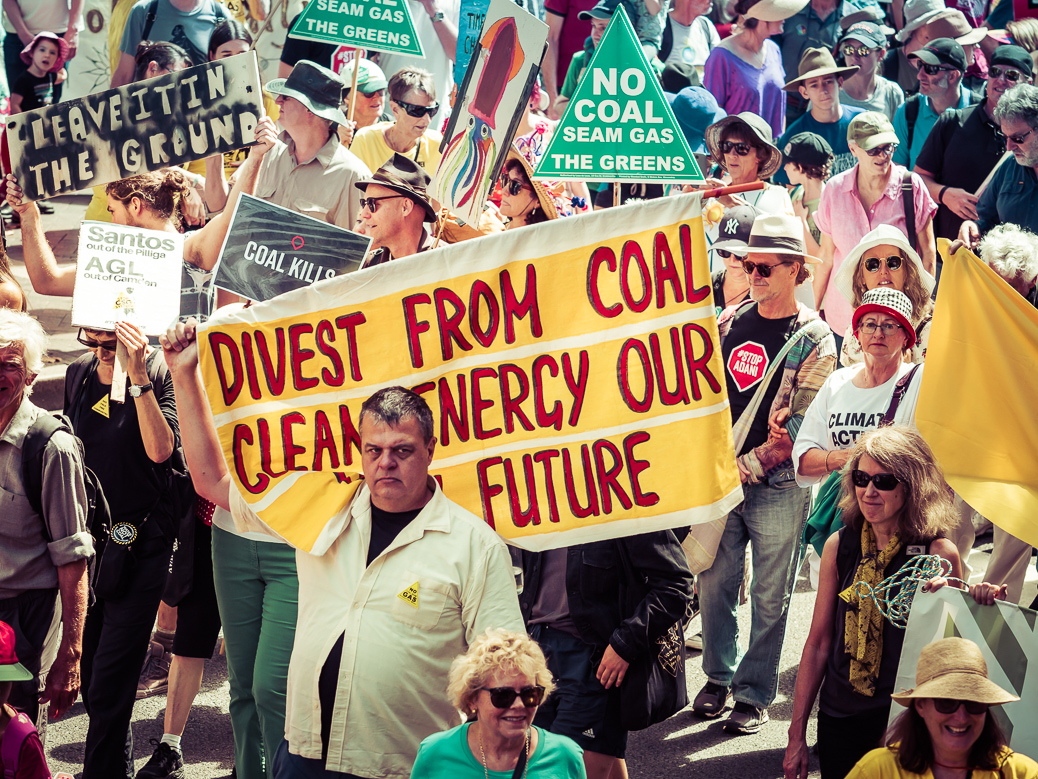
With the worsening impacts of climate change becoming ever more evident, environmental protest has used more spectacular interventions to garner public awareness and support. Here, media-savvy activists have used spectacle to generate public attention to their cause. This has included protest performances against corporate sponsorship of cultural institutions, the disruption of major sporting events, and the ‘culture jamming’ of corporate advertising and public relations. These new forms of protest seek to capture public attention and engagement through viral social media imagery and other communications that, echoing the strategy of Greenpeace’s founder Bob Hudson, act as ‘mind bombs’ in expanding the public’s understanding of the urgency of climate change.
Continue reading Protest as spectacle: On the counter-hegemonic potential of climate activismCategory Archives: politics
Management Scholars Discover Climate Change (too late!)
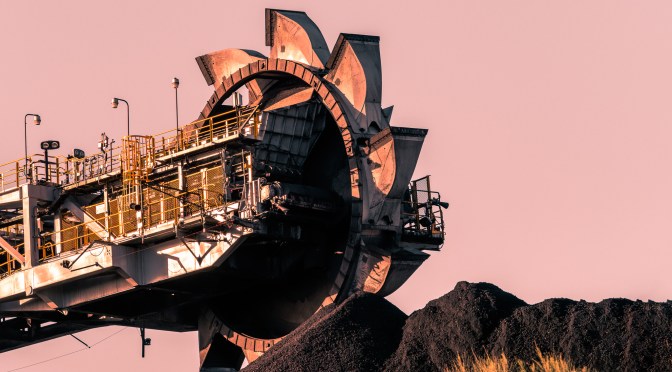
Recently, Daniel Nyberg and I were invited to contribute a short essay to the Journal of Management Inquiry as part of a themed discussion on ‘Climate Action Research: What’s Holding Us Back?’. Our contribution is reproduced below and argues that business and management scholarship has been particularly slow in focusing on the issue of anthropogenic climate disruption. In the essay we outline why this is and the need for management scholars to broaden their perspective on the relationship between corporate capitalism and the existential threats that humanity now faces in the climate era.
Continue reading Management Scholars Discover Climate Change (too late!)
Book Review: The Politics of Climate Change
Elke Schuessler from Leuphana University, Lüneburg has recently published this review of our book Organising Responses to Climate Change: The Politics of Mitigation, Adaptation in the journal Organization Studies. It contains some interesting reflections on our analysis and the implications for future management and organization research and is reproduced in full below.
Continue reading Book Review: The Politics of Climate Change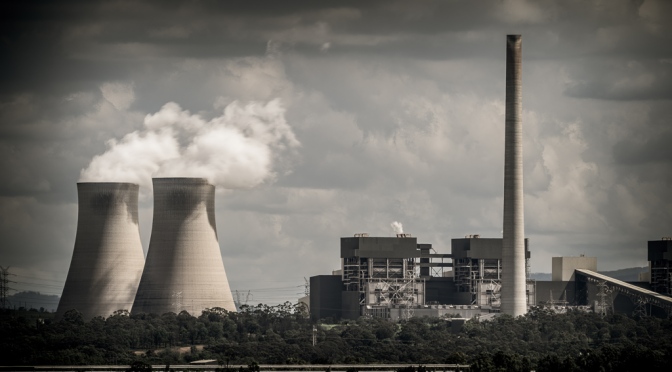
Book Review of “Organising Responses to Climate Change”
Hans Baer from the University of Melbourne has just published a review essay covering eight of the most recent books examining climate change and capitalism. The essay includes a review of our most recent book Organising Responses to Climate Change. The following is an extract from that review essay which can be found in full in the latest issue of the Journal of Australian Political Economy.
Continue reading Book Review of “Organising Responses to Climate Change”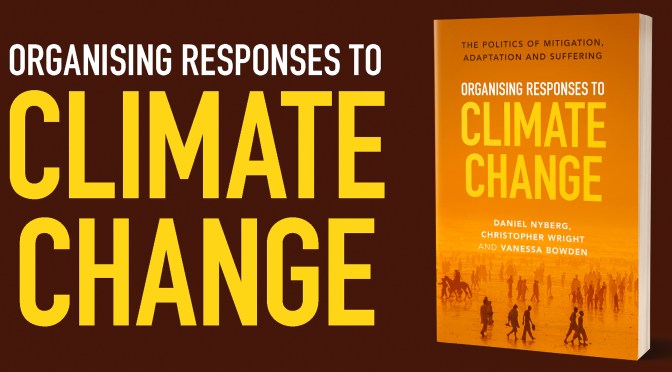
Organising responses to climate change: 2022 in review
2022 has been a particularly busy year in terms of my climate change research and teaching. With my co-researchers we’ve written and published a significant number of new journal articles exploring different aspects of the climate crisis, including:
- the political economy of climate adaptation on the Great Barrier Reef
- the role of celebrities in climate change disputes
- the maintenance of fossil fuel hegemony in Australian energy politics
- the growing criminalization of climate activism; and
- the neglect of climate change in business and management research
Coral Not Coal! The Roles of Celebrities in Climate Change Contestation
Celebrities are increasingly important actors in social disputes, with their high public profiles used to amplify political campaigns and businesses using celebrity endorsements to promote their brands and justify their actions. Celebrities are particularly prominent in climate politics in endorsing green issues, educating citizens about pressing environmental concerns, as well as potentially defending implicated industries from critique.
Continue reading Coral Not Coal! The Roles of Celebrities in Climate Change Contestation
From Denial to delay
In this current era of increasing climate activism, a key question that emerges is how the fossil fuel sector continues to avoid social and political sanction given the threat its activities pose to the future of human civilization? In a recently published paper in the journal Energy Research & Social Science, we investigated how the Australian fossil fuel sector has sought to maintain its political dominance in the face of growing social critique. Drawing on an analysis of media coverage and industry press releases during the period 2008-2019, we identified the core discourses underlying the Australian fossil fuel sector’s response to growing public concern over climate change and how these discourses stabilize the hegemonic project and defuse central themes of critique.
The following is a summary of the full article which can be viewed here.
Continue reading From Denial to delay
The political economy of the Climate Crisis in the Pacific
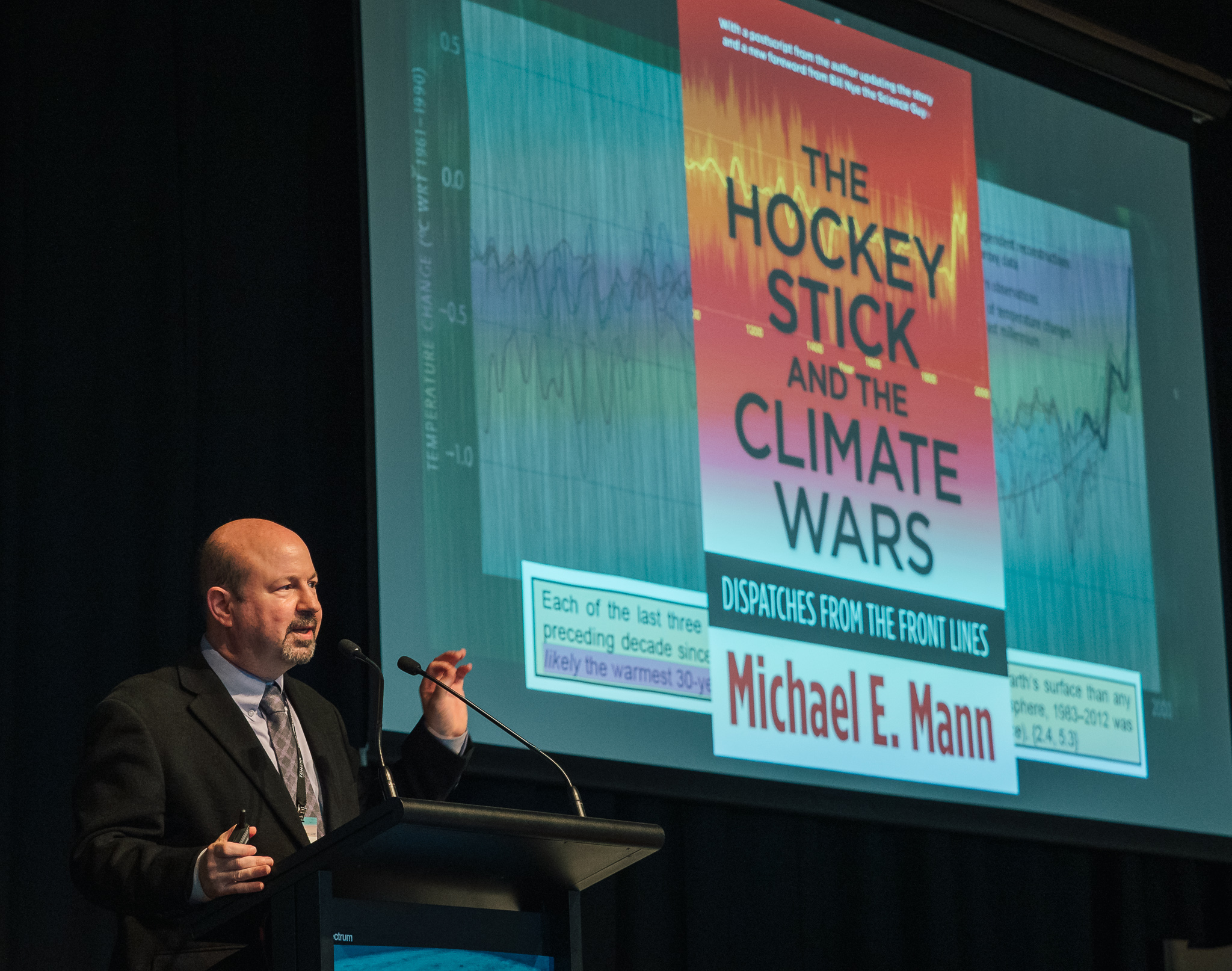
During 2018 I travelled to Wellington in New Zealand to participate in the second Pacific Climate Change Conference hosted by Victoria University and located in the amazing Te Papa Tongarewa Museum. It was a fascinating inter-disciplinary conference featuring international climate scientists such as Professor Michael Mann from Pennsylvania State University, as well as a diversity of social scientists, community representatives and activists from across the Pacific.

Best Critical Paper Winner: “Making Climate Change Fit for Capitalism: The Corporate Translation of Climate Adaptation”
A paper that Daniel Nyberg and I have authored on the corporate translation of climate change has won the best critical paper award at the prestigious Academy of Management conference in Boston, USA.
Our paper focuses on how a growing political response to calls for dramatic decarbonization has been to downplay the role of emissions mitigation and emphasize local forms of climate change adaptation. We explore this issue through the example of corporate responses to the catastrophic coral bleaching of the Great Barrier Reef during 2016/2017 and the process of corporate political activity which encouraged a shift in public debate from climate mitigation to adaptation.
In particular, we identify how corporations create a hegemonic ‘common sense’ view of politically contested issues and how interests are politicized and enacted in public debate. Through these actions, corporate solutions and self-regulation become accepted as the logical response to the climate crisis. Despite the worsening impact of climate change, these corporate responses ensure the maintenance of business as usual.
The research for this paper was generously funded by the Sydney Environment Institute and the University of Sydney Business School.
You can view or download a copy of the paper here.


A Climate of Denial: Coral Bleaching, Political Obfuscation, and the Climate Crisis
“It was catastrophic, gut wrenching and incredibly disturbing. That was one of the most comprehensive hard coral cover sites on the Reef and all of the coral in the shallows was fully bleached. That’s when we knew that we’d lost that site.”
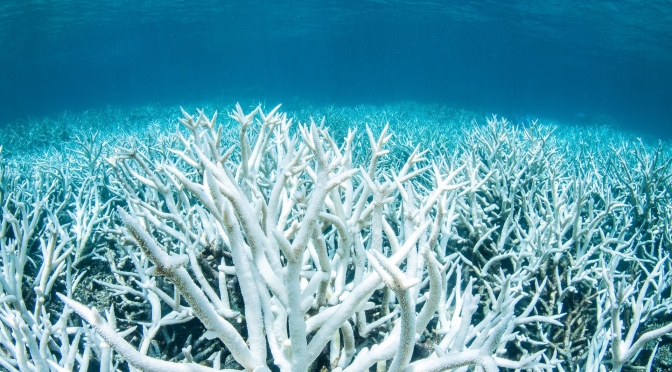
Our guide’s words cut through the sea breeze blustering over the stern of our dive boat. Our tour group of about thirty, were sitting in our wetsuits, warming ourselves after another dive on Opal Reef off Port Douglas, listening to Paul describe his reaction to that first coral bleaching event and trying to make sense of what we had just experienced: “In 2016, the world lost a lot of its living coral and the Great Barrier Reef was no exception. What’s causing it is global warming induced rises in water temperature.” That day we had seen stunning congregations of staghorn and branch coral, delicate sponges, vivid blue giant clams, large boulder corals metres across, and myriad fish coloured in reds and blues and greens darting in and out of our way. But we had also seen large swathes of dead coral on the top of the reef, their skeletal remains just discernible behind a shroud of algae.
Continue reading A Climate of Denial: Coral Bleaching, Political Obfuscation, and the Climate Crisis

Visualizing the Climate Crisis
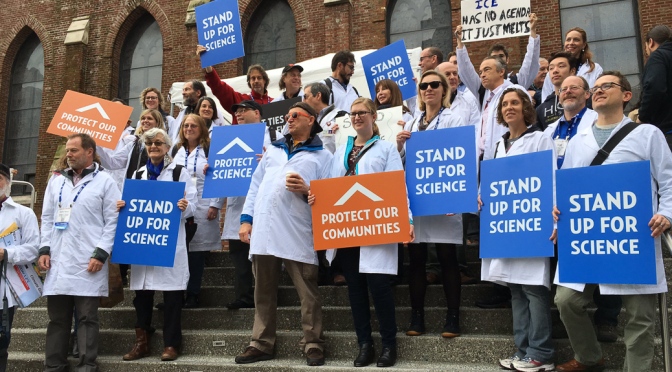
Recently I started exploring the possibility of combining my decade-long research focus on the climate crisis with my passion for photography. This idea began to develop after several years of photographing climate protest rallies and environment related events at the University of Sydney. However, the idea of a dedicated photography project documenting Australia’s fossil fuel addiction and the physical, social and political consequences of climate change really started to gel as I stood on banks of the Hunter River in Newcastle a few months back watching another huge bulk carrier entering the world’s largest coal port to take on another load of climate destroying fossil fuel.
Changing the World? Academic Impact, Activism and the Neoliberal University
Recently Carl Rhodes, Alison Pullen and I published an article in the journal Organization exploring the reframing of academic impact in the neoliberal university.
In the article we explore how ‘impact’ has become the buzzword of the contemporary university, and the value of academic research is increasingly judged by government, administrators and industry in terms of its contribution to economic growth and productivity. For example, the Australian Research Council (ARC)’s Research Impact Principles and Framework (2015) states that:
‘the Australian Government recognises the importance of research, science and innovation for increasing productivity and wellbeing to achieve long term economic growth for the Australian community’.
Continue reading Changing the World? Academic Impact, Activism and the Neoliberal University
Approaching the precipice? A review of Climate Change, Capitalism and Corporations
Professor Carl Rhodes of the University of Technology Sydney recently published an excellent review of our book Climate Change, Capitalism and Corporations: processes of Creative Self-Destruction in the journal Organization in July 2017. You can read the full review below.
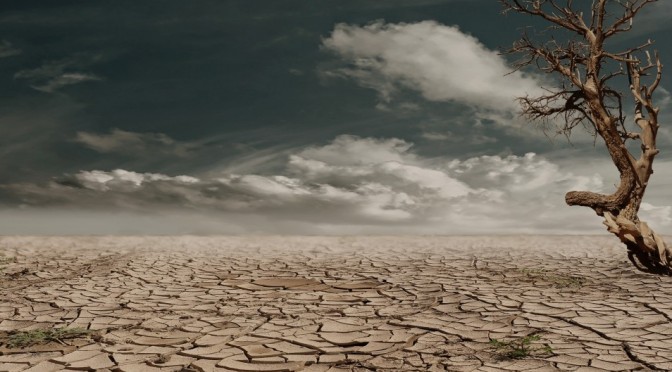
The cover of Christopher Wright and Daniel Nyberg’s Climate Change, Capitalism, and Corporations features the artwork Insatiable by Theodore Bolha and Christopher Davis. The image is dirty, brooding and apocalyptic. At its centre is a naked man, bent over and screaming. An industrial landscape weighs heavy on his back as black smoke pumps into the murky sky. As if about to fall to his knees and crawl, he follows a small group of wild animals all heading to a precipice, seemingly unaware of their impending doom. The image is suggestive of humankind’s bleak destiny wrought at the hands of its own creation yet seemingly beyond its own control. It is an ominous and pessimistic portrayal of the effects of an insatiable industrial machine. Continue reading Approaching the precipice? A review of Climate Change, Capitalism and Corporations
What if? Trump’s environmental legacy in 2019
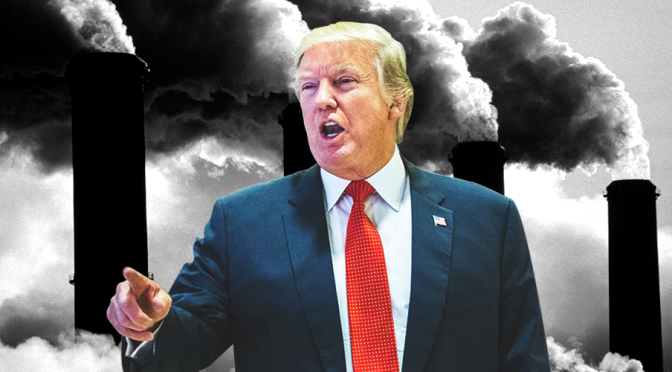
Shortly after the election of Donald J. Trump as 45th President of the United States in November last year, Jane Lê and I were asked by the University of Sydney Business School to imagine what the US would look like in 2019, two years into the new Presidency. So we cast caution to the wind and decided to record a ‘What If’ podcast imagining what Jan 2019 might look like in the US with respect to the environment, energy and climate change.
Continue reading What if? Trump’s environmental legacy in 2019
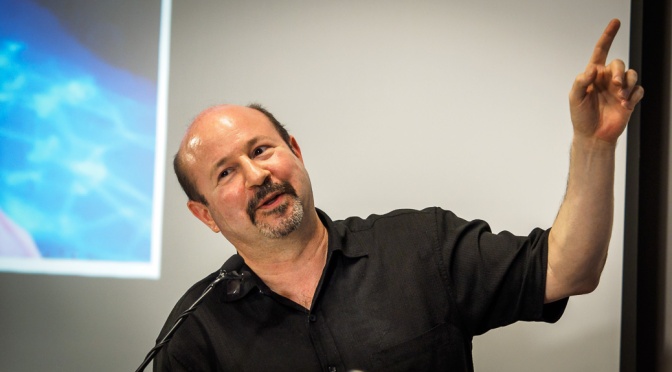
Professor Michael Mann in Australia
Last week the Sydney Environment Institute and the Balanced Enterprise Research Network at the University of Sydney Business School hosted a visit to Australia by world-renowned climate scientist Professor Michael Mann. Professor Mann is Distinguished Professor of Atmospheric Science at Penn State, with joint appointments in the Department of Geosciences and the Earth and Environmental Systems Institute (EESI). He is also director of the Penn State Earth System Science Center (ESSC).

