Tag Archives: Climate change

Climate change as a moral issue for business?

Last Monday Greens Leader Christine Milne delivered a landmark speech at the University of Sydney on the next steps for global warming policy around the world and Australia’s role as we approach the 21st Conference of the Parties (COP 21) in Paris this year.

I participated in the event as one of the respondents to Senator Milne’s address and was asked to comment on ‘what role business should play in effective climate change response?’ My response is set out below, but one theme that emerged in the discussion is whether business has an ethical responsibility in its response to climate change? I argue that it does, and this excellent article by David Roberts today highlights the broader way in which climate change is being viewed as a moral imperative and why this frightens those opposed to action on climate change. This an issue business seems unprepared to deal with, but as the climate crisis worsens and its moral implications become more apparent, it is one businesses need to increasingly engage with. Continue reading Climate change as a moral issue for business?

Book Review: This Changes Everything: Capitalism Vs. The Climate

It’s hard to know how to approach the phenomenon that is Naomi Klein’s This Changes Everything: Capitalism Vs. The Climate. In case you’ve been living in a remote cave for the last six months, this is the book that came out last September to rave reviews in the world’s major newspapers, which has been serialised on the front page of The Guardian over several days, and which has both left-wing commentators and even some conservatives singing its praises. There is also a documentary film coming out to accompany the book and sell out presentations by the author around the world linked to climate activist events. So this book comes with huge media fanfare and expectation. Continue reading Book Review: This Changes Everything: Capitalism Vs. The Climate

Risky business: Corporate constructions of climate change risk

As a growing number of studies have demonstrated, climate change poses a significant threat to future social and economic activities. Indeed, the language of ‘risk’ has become a perennial theme in discussions of future climate change impacts and a central construct for how businesses respond to and ‘manage’ climate change.

Recently Daniel Nyberg and I had an article accepted for publication in the journal Organization exploring how corporations have responded to climate uncertainties and threats as ‘risks’ (pre-print PDF here). Conventional cognitive-scientific depictions of risk see organisations as ontologically separate from the risk they act upon. The core assumption underlying risk management is that risk is ‘out there’ and it just has to be ‘found’ and ‘captured’ by professional experts using statistical tools and analysis.

Continue reading Risky business: Corporate constructions of climate change risk

Economic growth and climate change

With the coming G20 talks about to kick off in Brisbane, the focus of the agenda centres on economic growth as the panacea for all our troubles. Australian Prime Minister Tony Abbott and Treasurer Joe Hockey have been adamant in their focus upon the need to increase economic growth globally. It’s rare, if not impossible to find anyone in the mainstream public debate who questions the wisdom of ever-increasing economic growth. And yet there is a major underlying problem in our collective worship and addiction to growth – climate change.

Continue reading Economic growth and climate change

Climate change and the curse of creative self-destruction

Daniel Nyberg and Christopher Wright

Published in Mercury Magazine 2014, Summer/Autumn (Special Issue on Sustainability), Issue 7-8, pp. 042-049. Artwork by Bojan Jevtić.

As any student of economic history knows, the notion of destruction has been a grim constant in attempts to characterize the relationship between capitalist dynamism and ever-spiralling consumption. Marx and Engels warned of enforced destruction. Joseph Schumpeter championed a dauntless culture of creative destruction. And now we find ourselves in an era of what we might call creative self-destruction.

Continue reading Climate change and the curse of creative self-destruction

The Biodiversity Crisis: Environmental, Social and Economic Impacts

Humans are having an extraordinary impact on the life of the planet with species extinction rates now 100-1000 times the background rate. From a largely local phenomenon of habitat-loss and over-exploitation, biodiversity decline has now become systemic, driven by our increasingly globalized economy, expanding consumerism and accelerating climatic change. Indeed, many scientists believe we are in the midst of the sixth mass extinction event in the Earth’s history, and that the impacts on biodiversity, our life support system, will accelerate over the next century.

On October 7th, the Sydney Environment Institute (SEI) and the Balanced Enterprise Research Network (BERN) at the University of Sydney will be organizing a Sydney Ideas public lecture delivered by two of the country’s leading researchers on biodiversity decline from environmental and economic perspectives.

Professor Lesley Hughes from the Department of Biological Sciences at Macquarie University and the Climate Council will pose the question ‘Can Biodiversity Survive the Human Race?’. In her talk she will explore how we let things get this bad, whether we still have a chance to save the Earth, and what we can all do to avert catastrophe.

Our second speaker, Manfred Lenzen, Professor of Sustainability Research at the University of Sydney, will explore how globalization and international trade are key drivers of biodiversity decline. He will outline his research which charts how demand for consumer commodities in developed economies drives species extinction in developing countries.

Details for this exciting event can be found here.

Regional warlordism versus the digital panopticon

Visitors to this blog will know of my interest in climate futures, a subject I’ve published on in academic outlets. Recently I re-read British sociologist John Urry’s excellent article “Climate Change, Travel and Complex Futures”. I remember first reading this in 2008 and the future scenarios it outlined opened my eyes to the huge issue of climate change adaptation. Indeed, this article and Al Gore’s 2006 movie Inconvenient Truth were major influences in re-directing my research towards the issue of business responses to climate change (which this blog summarizes).

Continue reading Regional warlordism versus the digital panopticon

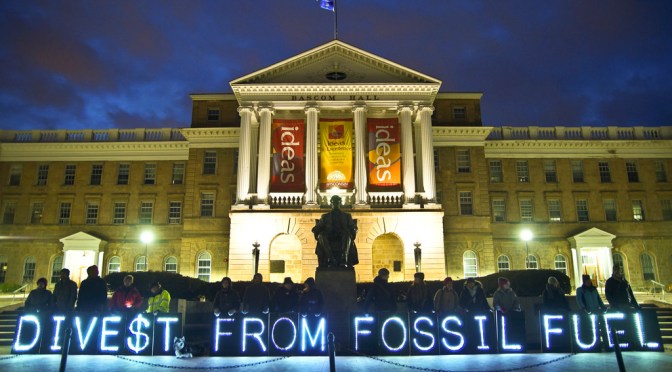
Fossil Fuel Divestment: Climate Proofing Your Finances

With the growing success of the divestment movement in the United States and concern over ‘stranded assets’ as the climate crisis exacerbates, the Balanced Enterprise Research Network (BERN) at the University of Sydney Business School, in association with 350.orgMarket Forces and the Australia Institute, hosted a panel discussion on Thursday 29th May exploring the potential for fossil free investment. You can view a video of the event below.

Continue reading Fossil Fuel Divestment: Climate Proofing Your Finances

Trying to cash in on climate change won’t fool nature

We find ourselves in an era of what we might call creative self-destruction. We’re destroying ourselves – it’s as simple as that.

Economic growth and exploiting nature’s resources have long gone hand-in-hand, but as repeated warnings from scientists and reports such as the latest from the IPCC tell us, they now constitute the most ill-fated of bedfellows. Climate change, the greatest threat of our time, is perhaps the definitive manifestation of the well-worn links between economic progress and devastation.

Continue reading Trying to cash in on climate change won’t fool nature

Why Business ‘Leading’ on Climate Change is a Problem

So it has come to this. Despite a mountain of scientific evidence emphasising the catastrophic implications of human-induced climate change, governments seem unable to take any significant steps to break humanity’s addiction to fossil fuels. As Chris Hayes recently noted, having been confronted with the fact of our addiction we now are in the full throws of denial; ‘it’s not that bad’, ‘we need fossil fuels to prosper and grow’, ‘one more fossil fuel development won’t matter’, ‘how bad can it be?’ etc.  For governments and politicians long inculcated in the interests of the market and short-term corporate profit, the maintenance of a habitable atmosphere now appears something we are willing to forgo.

Continue reading Why Business ‘Leading’ on Climate Change is a Problem

The Politics of Climate Change Research Funding

Readers may remember that back in November, Queensland Liberal Senator Ian Macdonald caused some consternation when he characterised the ‘appalling’ situation of too much research funding being devoted to climate change! Explicit in the Senator’s statement was an argument that competitive grants had been subject to political influence under the former Federal Labor Government. As Senator Macdonald stated:

I also know that a number of scientists—and I have had personal interaction with some of them—who wanted to do research that did not follow the then government’s view of climate change would never ever get a grant from the Australian Research Council. That seemed to me, if that were the case—and I accept what was told to me—that the Research Council was actually following a dictum from the then government about climate change and climate change research.

Continue reading The Politics of Climate Change Research Funding

We are The Borg – So is Resistance to Climate Catastrophe Futile?

Recently I came across this excellent short video of our likely climate future based on recent IPCC reviews. Produced by Globaia, this visualisation is quite effective in trying to comprehend the impact humanity is having upon the Earth’s climate and ecosystem at a global scale; popularised in the concept of the ‘Anthropocene‘.

In reviewing the current social debate around climate change, I’m often reminded of the similarities between our current climate crisis and popular culture references in books and film. There is a rich vein of dystopian literature and related movies that tap into this zeitgeist of environmental disaster, overpopulation and apocalypse (for a reflection on this see Kathryn Yusoff and Jennifer Gabrys’ article ‘Climate Change and the Imagination’).

Continue reading We are The Borg – So is Resistance to Climate Catastrophe Futile?

Book Launch: Climate-Challenged Society & Globalization and the Environment

ScreenHunter_51 Nov. 22 19.19

Australia has long been known for its environmental politics – movements, policy, and academic analysis. On Wednesday 11th December, four of the most well-known Australia-based academics of environmental politics from the University of Sydney, University of Melbourne, and Australian National University will convene to discuss and celebrate two recent books aimed at analysing and stimulating debate on the current and future state of environmental and climate politics.

Continue reading Book Launch: Climate-Challenged Society & Globalization and the Environment

Making Our Planetary Suicide a ‘Rational’ Project

Superstorm Sandy damage in Seaside Heights New Jersey (Image: Anthony Quintano)

Over the last year or so, Daniel Nyberg and I have been writing a paper exploring the role of political myths in underpinning corporate responses to climate change. The paper has now been published online in the journal Environmental Politics, and you can download a PDF of the article here. I’ve also presented the paper in a Sydney Environment Institute seminar (audio file below).

Continue reading Making Our Planetary Suicide a ‘Rational’ Project