Category Archives: sustainability

Management Scholars Discover Climate Change (too late!)

Recently, Daniel Nyberg and I were invited to contribute a short essay to the Journal of Management Inquiry as part of a themed discussion on ‘Climate Action Research: What’s Holding Us Back?’. Our contribution is reproduced below and argues that business and management scholarship has been particularly slow in focusing on the issue of anthropogenic climate disruption. In the essay we outline why this is and the need for management scholars to broaden their perspective on the relationship between corporate capitalism and the existential threats that humanity now faces in the climate era.

Confronting the Big Picture: Climate Change, Capitalism, and Management Scholarship

Christopher Wright and Daniel Nyberg

The neglect of climate change in business and management research has been a long-term trend (Goodall, 2008Nyberg & Wright, 2022a). Yet, in the last few years it seems management scholars have finally recognized climate change as an issue of concern. Climate change now features in the pantheon of “grand challenges” that management scholars increasingly profess to address (George et al., 2016), and most business schools now routinely genuflect toward the discourse of “sustainability” and the colorful iconography of the UN SDGs (Miotto et al., 2020).

The irony of this is somewhat stark given how late in the day it really is. After all, the science of the greenhouse effect and anthropogenic climate disruption is centuries old (Weart, 2011), American presidents were being warned of the existential implications of global warming from the mid-1960s (Nuccitelli, 2015), and oil companies’ own internal research had established the link between their products and global warming during the 1970s (Supran & Oreskes, 2017). From the late 1980s, climate change became institutionalized within annual international climate negotiations, yet as the scientific data increased on the dire threat facing humanity, greenhouse gas emissions and atmospheric concentrations of carbon dioxide and methane continued to grow (Heede, 2014). As the world heats to unprecedented levels and the tipping points of Greenland, the Amazon and the west Antarctic ice sheets become reality, it now seems management scholarship has finally woken up! But to what, one might ask?

Despite the growing attention to the climate crisis in management research, there is a notable failure to come to grips with the phenomenon itself. Much management writing on climate change defaults to the more nebulous concerns of “sustainability,” “business greening,” and the discursive fashion of “net-zero.” But missing from most of these accounts is any understanding of the fundamental nature of the problem the developed world has created. The exploitation of fossil energy in the form of coal, oil, and gas, during the nineteenth and twentieth centuries facilitated the dramatic expansion of industrial activity and the “Great Acceleration” of globalized corporate capitalism (Steffen et al., 2015Wright & Nyberg, 2015). Fossil energy enabled the fantasy that the human species was now free from the constraints of the natural world and could exist somehow independent from its physical limits (Malm, 2016). Humans could, it seems, conquer nature, extracting from it endless productive inputs, while also using it as a sink for capitalism’s ceaseless waste (of which greenhouse gases are perhaps its most profound legacy). A small proportion of the human species could now live as gods, free from the hardships of food and energy scarcity and consume at a scale beyond the imagination of their forebears. However, it was always a mirage, a form of magical thinking, and now in this age of consequences we are finally becoming aware of the huge cost of such hubris.

Yet it is our embedded relationship to the natural world and the web of life; the endless complexity of interrelated species and elements that we call “nature,” that is largely absent from management scholarship. Perhaps shaped by the underlying influence of neoclassical economics, management researchers and business schools view the natural environment as something of a distraction from the process of economic value creation. From our earliest days in undergraduate lectures, it was drummed into us that the economy was where the action was, and nature was defined out of the equation, an “externality” that we need not concern ourselves with. As Rae André points out in this current exchange, this myopia has been compounded for management and business scholars through the obsession with the micro functioning of the business organization (in terms of the strategy and structure of the firm and its functional specializations). If climate change is to be acknowledged, it must be incorporated within the logic of the firm; a “business case” of risk and opportunity (Lash & Wellington, 2007). Unsurprisingly, when climate change is considered, the discussion moves toward the reduction of these business risks resulting from climate disruption and the capture of monetary opportunities (new products and markets) in a changing physical world (Nyberg et al., 2022). This focus on “risk,” of which this curated discussion is themed, is itself problematic: risk for whom and what? Clearly not all of humanity have equally contributed to the current climate crisis, nor are its impacts equally shared (evident in the huge climate inequalities facing the Global South and future generations!). Invariably, the “solutions” that corporations and their advisers promote emphasize corporate innovation, new technologies and market mechanisms as the focus of climate response, ignoring the fact that it is these very activities that have generated the current crisis. Given then that climate change now threatens not only the near future of organized human civilization, but also much of life on the planet, what should management scholars do?

First, there is a need for us as management scholars to recognize and better communicate the true nature of the problem in our research and teaching. Human-induced disruption of the climate is a direct result of a global capitalist economic system reliant on compound growth ad infinitum and dependent upon the continued extraction and combustion of fossil energy. Indeed, coal, oil, and gas still provide more than 80% of total global energy consumption, a figure only marginally less than was the case 50 years ago (IEA, 2021). This extends across the production of energy, into manufacturing, transport, food, and agriculture (IPCC, 2023). Thus, calls for “greening” business, greater eco-efficiency, and managing risk miss this basic truth, implying that it is sufficient to simply tweak a global economic system which is destroying the very life-support systems of the planet. Here, we would take issue with Gioia’s (2024) argument, noted in the introduction to this exchange, that climate change is an expression of “collective stupidity” and that business will lead in responding to it. The climate crisis is, we would argue, not an expression of stupidity, but rather the result of conscious planning by corporate and political leaders who view this as the desired reality; what Fisher (2009) has termed “capitalist realism.” Moreover, the current political responses to the climate crisis reveal that business is “leading,” however it is doing so in ways that lock in the continuation of business as usual and obfuscate the need for a far more radical alternative imaginary (Nyberg et al., 2022Wright & Nyberg, 2017).

Second, having recognized the fundamental nature of the climate crisis, as management scholars we need to start having honest conversations about alternatives to our current economic and political system; a fundamental rethink of how our societies could be organized differently. As André and Hoffman and Jennings argue in their essays, this means going beyond the narrow theories of business studies and engaging with a truly multidisciplinary perspective, drawing on insights from political economy, geography, climate science, and the broader humanities. We need to expand our intellectual horizon beyond just stakeholder theories of existing business models to a more fundamental recognition of the planetary boundaries humanity must work within and the complex political processes implicit in a more equitable sharing of the basic needs of human and non-human well-being (Raworth, 2017). It means challenging the assumptions of economic growth and seriously considering how issues of “degrowth” and “sufficiency” can inform social organization (Hickel, 2020). It involves taking seriously calls for greater deliberative democracy that extends beyond the façade of political representation and involve communities in making decisions about their lives and futures free from the malign influence of oligarchic power (Willis et al., 2022). As the other contributors have noted, there are institutional reasons why this is difficult in our universities given the siloed nature of expertise and how this is rewarded and incentivized. University collaborations across disciplines are further hampered by the influence of the fossil-fuel industry in higher education (Lachapelle et al., 2024). So, while climate change provides a viable setting for challenging these disciplinary boundaries as well as an opportunity for new insights and learning for ourselves and our students, it also requires challenging the financialization of universities and their dependence on special interests.

Of course, these are huge, consequential social agendas, but they are also the issues that now matter the most if humanity is to have a future. Moreover, these are the concerns that management and organizational scholars should be addressing if they are to have any relevance in a world in freefall. Continuing to address the intricacies of corporate activities and shareholder value maximization is a comforting illusion, however maintaining business scholarship as usual simply perpetuates an economic and political system that is locking in our creative self-destruction, as scholars, as societies, and as a species (Wright & Nyberg, 2015). We need to dream bigger!
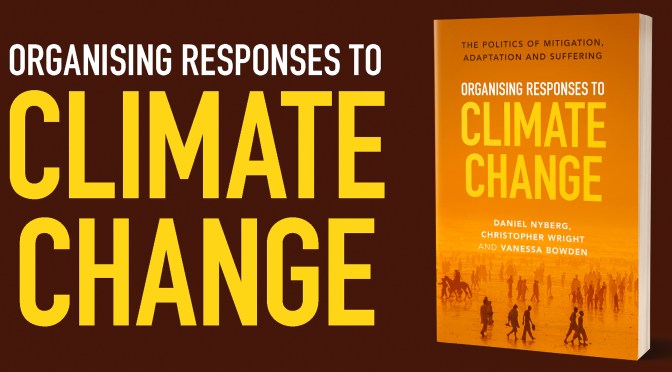

Organising responses to climate change: 2022 in review

2022 has been a particularly busy year in terms of my climate change research and teaching. With my co-researchers we’ve written and published a significant number of new journal articles exploring different aspects of the climate crisis, including:

Continue reading Organising responses to climate change: 2022 in review

AI has just made the university essay redundant!

So here’s a blog post a little different to my usual climate change doom-saying! This week, several colleagues at different universities drew my attention to the growing online discussion about the upgrade of an open-access AI chat application GPT-3 that can now handle complex instructions and produce coherent long-form responses.

Continue reading AI has just made the university essay redundant!

Why Business Won’t Save Us From Climate Change

Climate change is now the ever-present reality of human experience. In recent times we have witnessed a procession of huge hurricanes batter the US and Caribbean, record-breaking monsoons flooding Asia, and in Australia, despite the death of up to half of the Great Barrier Reef in back-to-back coral bleaching events, political support for new mega-coal mines and coal-fired power stations. While there is now clear scientific agreement that the world is on track for global temperature increases of as much as 4 degrees Celsius by century’s end (threatening the very viability of human civilization), our political and economic masters continue to double down on the fossil fuel bet, transforming perhaps the greatest threat to life on this planet into ‘business as usual’.

Continue reading Why Business Won’t Save Us From Climate Change

Approaching the precipice? A review of Climate Change, Capitalism and Corporations

Professor Carl Rhodes of the University of Technology Sydney recently published an excellent review of our book Climate Change, Capitalism and Corporations: processes of Creative Self-Destruction in the journal Organization in July 2017. You can read the full review below.

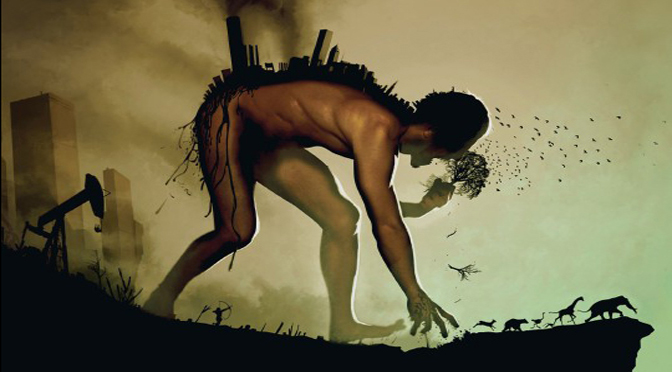
The cover of Christopher Wright and Daniel Nyberg’s Climate Change, Capitalism, and Corporations features the artwork Insatiable by Theodore Bolha and Christopher Davis. The image is dirty, brooding and apocalyptic. At its centre is a naked man, bent over and screaming. An industrial landscape weighs heavy on his back as black smoke pumps into the murky sky. As if about to fall to his knees and crawl, he follows a small group of wild animals all heading to a precipice, seemingly unaware of their impending doom. The image is suggestive of humankind’s bleak destiny wrought at the hands of its own creation yet seemingly beyond its own control. It is an ominous and pessimistic portrayal of the effects of an insatiable industrial machine. Continue reading Approaching the precipice? A review of Climate Change, Capitalism and Corporations

How coastline communities are trying to build climate change ‘resilience’

Earlier this week I participated in a fascinating symposium organised by the Gold Coast Waterways Authority on ‘Resilience, Climate Change and Coastal Communities’. Queensland’s Gold Coast is one of the more vulnerable locations along Australia’s east coast, having experienced a long history of extreme weather events, coastal erosion and loss of life and property. Climate change is likely to take this vulnerability to a whole new level with storms and cyclones of increasing ferocity, flooding, extreme heat and escalating sea-level rise.

Continue reading How coastline communities are trying to build climate change ‘resilience’

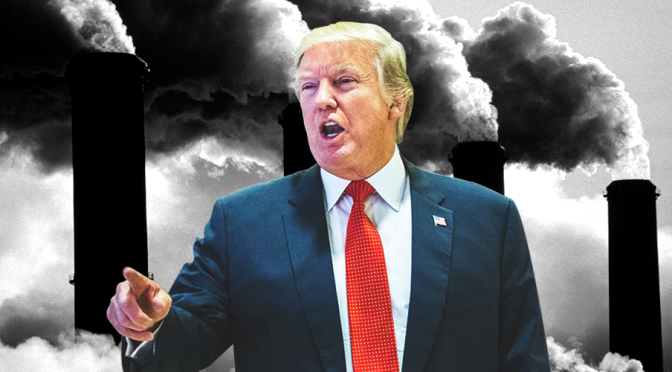
What if? Trump’s environmental legacy in 2019

Shortly after the election of Donald J. Trump as 45th President of the United States in November last year, Jane Lê and I were asked by the University of Sydney Business School to imagine what the US would look like in 2019, two years into the new Presidency. So we cast caution to the wind and decided to record a ‘What If’ podcast imagining what Jan 2019 might look like in the US with respect to the environment, energy and climate change.

Continue reading What if? Trump’s environmental legacy in 2019

Review of A Friend of the Earth

Originally published in 2000, A Friend of the Earth by T. C. Boyle is a gripping, humorous and emotional novel which charts the life of committed eco-activist Ty Tierwater and his battles to confront humanity’s destruction of nature. I first encountered an excerpt from this book several years ago when reading the anthology I’m With The Bears: Short Stories From a Damaged Planet. The chapter ‘The Siskiyou, July 1989’ was something of a revelation for me then, a powerful, slow-reveal vignette in which a man, his wife, young daughter and another set out under cover of night on an arduous and forlorn protest against the logging of the virgin Oregon forest. The horror builds as you realise not only of the protestors’ helplessness when confronted by the loggers and the local police, but also in the love of a father for his daughter as they endure the physical and psychological torment of their protest. Boyle captures both the comedy and torment of a father torn between the love of his daughter and his attempts to fight against humanity’s rampant ecocide. As I started to read A Friend of the Earth this last fortnight, I recalled this tale and realised that this was a novel that speaks directly to one of the key dilemmas of our time: how one makes sense of the destruction of the natural world. Continue reading Review of A Friend of the Earth

Capital & Class Review of Climate Change, Capitalism and Corporations

Book Review: Climate Change, Capitalism, and Corporations. Processes of Creative Self-Destruction by Christopher Wright and Daniel Nyberg, Capital & Class, 40(2), pp.394-396, doi:10.1177/0309816816661148n

Marc Hudson, Sustainable Consumption Institute, University of Manchester.

In December 2015 world leaders gathered to proclaim climate change was a threat that they were (finally) going to do something about. After two weeks of speeches and haggling, the deal was done, the world saved. Never mind that the text was silent on fossil fuels, and that in the following week the UK government expanded fracking, the US rescinded a forty year old ban on oil exports and Australia gave new permits for coal mines. Those are minor pesky details; corporate capitalism has the best interests of everyone – rich, poor, black, white, the unborn generations to come, other species – at heart. Continue reading Capital & Class Review of Climate Change, Capitalism and Corporations

Teaching sustainability in the business school: Challenging Business As Usual?

Sustainability has become an increasingly fashionable concept in management education as business schools seek to respond to growing social criticism of business activities. Unfortunately, much of what passes for sustainability teaching involves co-option of the concept of sustainability within existing neoliberal discourse. So, is teaching sustainability in a meaningful way possible in the business school, and if so what might it look like? Recently Daniel Nyberg and I wrote a chapter for a book on Reinventing Management Education that seeks to address this question (you can read a pre-publication version here). What follows is a summary of some of our arguments. Continue reading Teaching sustainability in the business school: Challenging Business As Usual?

Explaining Creative Self-Destruction and the Climate Crisis

Recently, Daniel Nyberg and I did an interview with Catherine Zengerer on radio station 2SER’s “On the Money” show about our new book Climate Change, Capitalism and Corporations: Processes of Creative Self-Destruction.

The interview is a good outline of many of the core arguments in our book. As the summary accompanying the interview outlines:

With climate change an impending reality it seems the world has a problem with overconsumption. But according to two business professors we are failing to address the very cause of climate change – capitalism.

Neoliberal economists argue that climate change – a market problem, is addressed by a market solution. But according to Professor Christopher Wright and Professor Daniel Nyberg more consumption is not the solution in a society where the environmental model is often traded off for a business model. Can we have our cake and eat it too?

You can hear the full interview (about 10 minutes) here.


Creative Self-Destruction and the Climate

Leading public intellectual and Professor of Public Ethics at Charles Sturt University, Clive Hamilton very generously wrote the excellent Foreword to our new book Climate Change, Capitalism and Corporations: processes of Creative Destruction.  Below is an adapted version of that Foreword recently published in The Conversation.

——-

In his 2006 landmark report on how we should respond to the climate crisis, Nicholas Stern characterised global warming as an ‘externality’, a damage to others due to market activity whose cost is not met by those who cause it. Continue reading Creative Self-Destruction and the Climate

New book on Climate Change, Capitalism and Corporations

Our new book Climate Change, Capitalism, and Corporations: Processes of Creative Self-Destruction has just been published. Based on research that Daniel Nyberg and I have been conducting over the last 6 years, the book explores the complex relationship that the corporate world has with climate change and the central role corporations play in shaping political and social responses to the climate crisis.

In the book, we explore the different processes through which corporations engage with climate change. The principal message is that despite the need for dramatic economic and political change, corporate capitalism continues to rely on the maintenance of ‘business as usual’. As outlined in this short summary in The Conversation this involves the myth that ‘green’ capitalism is a viable response to the climate crisis. This response enables the incorporation of critique and the maintenance of corporate capitalism despite the dire environmental consequences. Continue reading New book on Climate Change, Capitalism and Corporations

Representing Climate Change?

Writing about climate change often requires some type of visual reference particularly given the way our eyes are drawn to the visual in social media settings and more generally in public debate. But how do you visually represent the human-induced climate disruption we are now living through? As Naomi Klein has demonstrated so powerfully, climate change ‘changes everything’! And yet despite its profound impacts, it is a phenomenon that is also diffuse across space and time.

This was an issue that I confronted late last year when Daniel Nyberg and I completed the manuscript for our forthcoming book Climate Change, Capitalism and Corporations: Processes of Creative Self-Destruction. With the draft manuscript sent off to the publishers, we then agonised over the book cover design. An early offer from the publishers presented a somewhat anodyne image of suited business people on an  escalator (the sort of thing one sees everyday on management textbook covers) – probably relevant in that context but nothing really about climate change. Continue reading Representing Climate Change?

Climate Change, Capitalism and Corporations out in September

Our new book Climate Change, Capitalism, and Corporations: Processes of Creative Self-Destruction will be released in both paperback and hardback in late September. You can view the website for the book here.

Based on research that Daniel Nyberg and I have been conducting over the last 6 years, the book explores the complex relationship that the corporate world has with climate change and examines the central role of corporations in shaping political and social responses to the climate crisis. Continue reading Climate Change, Capitalism and Corporations out in September