Category Archives: Research

The Age of Neo-bureaucracy

A common theme in popular business discourse is the demise of bureaucracy and the emergence of a new, more liberating post-bureaucratic era. While subject to variation, common themes in this genre include organisations becoming less insular, hierarchical and rule-bound and more change-focused, enterprising and collaborative. Indeed, the persona of the manager as leader is a recurring image. A ‘high-flyer’, familiar with consulting and MBA techniques, experienced in a wide range of industry settings and jumping from one corporate turnaround to the next.

But as is so often the case in claims of fundamental change, there is good reason to be sceptical about the demise of bureaucracy and the birth of this ‘new’ 21st century organisational ideal. In our recent book Management as Consultancy: Neo-bureaucracy and the Consultant Manager, Andrew Sturdy, Nick Wylie and I argue that while large organisations are changing, there are also strong resonances with the past. Based on an extensive analysis of Australian and British corporations, we find that managers are becoming less explicitly hierarchical and more market and change oriented. Continue reading The Age of Neo-bureaucracy

The corporate creation of an engaging ‘green’ spectacle

The following is an extract from our forthcoming book Climate Change, Capitalism and Corporations: Processes of Creative Self-destruction (Cambridge University Press) - out in bookshops later this year.

Corporate marketing and branding around sustainability and ‘green’ themes has undergone dynamic growth over the past decade as social concern over the environment and climate change has spiralled. Many major consumer brands – including Walmart, Ben & Jerry’s, GE, Toyota, Patagonia, Frito-Lay, Timberland, Tesco and even Shell – have embraced a ‘green’ message in their marketing.

A principal aim has been to successfully tap into consumers’ increased environmental awareness while avoiding allegations of duplicity or ‘greenwashing’. Guy Pearse has documented that there is often a disconnect between the ‘green’ boasts of corporate advertising and the reality of environmental impact. A selective focus on specific products and activities is sometimes exposed, as are assertions that are simply inaccurate; but what remains unmistakable in all such activities is an emphasis on evoking positive emotions among consumers and the public in general as part of an alternative emotionology of challenge and opportunity.

Continue reading The corporate creation of an engaging ‘green’ spectacle

Risky business: Corporate constructions of climate change risk

As a growing number of studies have demonstrated, climate change poses a significant threat to future social and economic activities. Indeed, the language of ‘risk’ has become a perennial theme in discussions of future climate change impacts and a central construct for how businesses respond to and ‘manage’ climate change.

Recently Daniel Nyberg and I had an article accepted for publication in the journal Organization exploring how corporations have responded to climate uncertainties and threats as ‘risks’ (pre-print PDF here). Conventional cognitive-scientific depictions of risk see organisations as ontologically separate from the risk they act upon. The core assumption underlying risk management is that risk is ‘out there’ and it just has to be ‘found’ and ‘captured’ by professional experts using statistical tools and analysis.

Continue reading Risky business: Corporate constructions of climate change risk

Climate change and the curse of creative self-destruction

Daniel Nyberg and Christopher Wright

Published in Mercury Magazine 2014, Summer/Autumn (Special Issue on Sustainability), Issue 7-8, pp. 042-049. Artwork by Bojan Jevtić.

As any student of economic history knows, the notion of destruction has been a grim constant in attempts to characterize the relationship between capitalist dynamism and ever-spiralling consumption. Marx and Engels warned of enforced destruction. Joseph Schumpeter championed a dauntless culture of creative destruction. And now we find ourselves in an era of what we might call creative self-destruction.

Continue reading Climate change and the curse of creative self-destruction

Regional warlordism versus the digital panopticon

Visitors to this blog will know of my interest in climate futures, a subject I’ve published on in academic outlets. Recently I re-read British sociologist John Urry’s excellent article “Climate Change, Travel and Complex Futures”. I remember first reading this in 2008 and the future scenarios it outlined opened my eyes to the huge issue of climate change adaptation. Indeed, this article and Al Gore’s 2006 movie Inconvenient Truth were major influences in re-directing my research towards the issue of business responses to climate change (which this blog summarizes).

Continue reading Regional warlordism versus the digital panopticon

Trying to cash in on climate change won’t fool nature

We find ourselves in an era of what we might call creative self-destruction. We’re destroying ourselves – it’s as simple as that.

Economic growth and exploiting nature’s resources have long gone hand-in-hand, but as repeated warnings from scientists and reports such as the latest from the IPCC tell us, they now constitute the most ill-fated of bedfellows. Climate change, the greatest threat of our time, is perhaps the definitive manifestation of the well-worn links between economic progress and devastation.

Continue reading Trying to cash in on climate change won’t fool nature

The Politics of Climate Change Research Funding

Readers may remember that back in November, Queensland Liberal Senator Ian Macdonald caused some consternation when he characterised the ‘appalling’ situation of too much research funding being devoted to climate change! Explicit in the Senator’s statement was an argument that competitive grants had been subject to political influence under the former Federal Labor Government. As Senator Macdonald stated:

I also know that a number of scientists—and I have had personal interaction with some of them—who wanted to do research that did not follow the then government’s view of climate change would never ever get a grant from the Australian Research Council. That seemed to me, if that were the case—and I accept what was told to me—that the Research Council was actually following a dictum from the then government about climate change and climate change research.

Continue reading The Politics of Climate Change Research Funding

Book Launch: Climate-Challenged Society & Globalization and the Environment

ScreenHunter_51 Nov. 22 19.19

Australia has long been known for its environmental politics – movements, policy, and academic analysis. On Wednesday 11th December, four of the most well-known Australia-based academics of environmental politics from the University of Sydney, University of Melbourne, and Australian National University will convene to discuss and celebrate two recent books aimed at analysing and stimulating debate on the current and future state of environmental and climate politics.

Continue reading Book Launch: Climate-Challenged Society & Globalization and the Environment

Researching Climate Change in an Era of Political Denial

99129170_7d542023a6_o

That the social debate around climate change is a ‘culture war’ should come as no surprise to anyone observing current political debate in Australia, the US, UK and Canada. In contrast to much of the rest of the world where climate science is rarely debated, in the Anglo-Saxon world the culture war around climate change rages on with increasing vehemence.

Continue reading Researching Climate Change in an Era of Political Denial

Making Our Planetary Suicide a ‘Rational’ Project

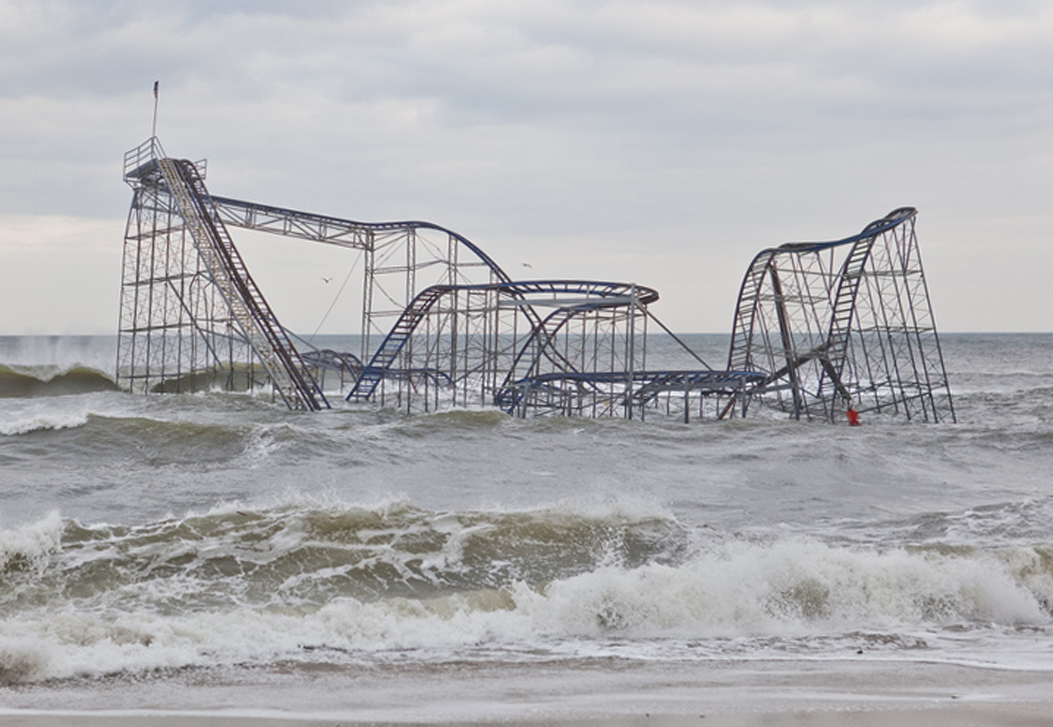
Superstorm Sandy damage in Seaside Heights New Jersey (Image: Anthony Quintano)

Over the last year or so, Daniel Nyberg and I have been writing a paper exploring the role of political myths in underpinning corporate responses to climate change. The paper has now been published online in the journal Environmental Politics, and you can download a PDF of the article here. I’ve also presented the paper in a Sydney Environment Institute seminar (audio file below).

Continue reading Making Our Planetary Suicide a ‘Rational’ Project

IPCC 2013 and Creative Self Destruction Redux

Image: Christopher Wright

Well the IPCC‘s latest scientific report has come out confirming what many of us have suspected – that anthropogenic climate change is on track with previous worst-case scenarios and the future prognosis is bleak. Given the IPCC is by its nature a conservative organisation, it seems likely that as before, the current report may well underestimate some climate impacts. Be that as it may, this is startling and confronting  to read given the import of its conclusions.

Continue reading IPCC 2013 and Creative Self Destruction Redux

Launch of the Sydney Environment Institute

ScreenHunter_50 Sep. 21 22.09

Last Tuesday evening I attended the launch of the new Sydney Environment Institute (SEI) at the University of Sydney. SEI is a cross-Faculty research institute which aims to address two of the key questions of our time:

  • how do we understand and redesign the fundamental relationship between human communities and the natural world that supports them; and
  • how can people and societies adapt positively to environmental change?

Continue reading Launch of the Sydney Environment Institute

Imagining Our Climate Changed Future

3972775207_7da7d4af1d_o

Climate change has rapidly emerged as a major threat to our future. Indeed the increasingly dire projections of increasing global temperatures and escalating extreme weather events highlight the existential challenge that climate change presents for humanity.

In popular and political discourse, climate change is depicted as an environmental or ‘natural’ problem that requires ‘rational’ responses based on scientific evidence. However, there is also a need to view climate change as a social and politically embedded phenomenon, linked to patterns of production and consumption and the ideological assumptions that underpin the economic system and our collective sensemaking processes.

Continue reading Imagining Our Climate Changed Future

New research network focuses on sustainability and business

In the decade ahead, Australia and the world will face environmental, social and financial challenges of an unprecedented scale. These include tensions between economic growth and environmental degradation, a need to dramatically reduce greenhouse gas emissions in response to climate change, and pressure to improve social inclusion and equity in a world of significant poverty and inequity. Businesses are clearly key players when it comes to responding to these challenges, but can businesses look beyond their short-term bottom line and better balance their economic needs with social and environmental priorities?

In focusing on these issues, recently the University of Sydney Business School launched its Balanced Enterprise Research Network (BERN) which explores how business in particular, can better balance economic, environmental and social concerns and improve the well-being of a wide range of stakeholders, including employees, communities and society more generally.

Continue reading New research network focuses on sustainability and business