The Age of Neo-bureaucracy

A common theme in popular business discourse is the demise of bureaucracy and the emergence of a new, more liberating post-bureaucratic era. While subject to variation, common themes in this genre include organisations becoming less insular, hierarchical and rule-bound and more change-focused, enterprising and collaborative. Indeed, the persona of the manager as leader is a recurring image. A ‘high-flyer’, familiar with consulting and MBA techniques, experienced in a wide range of industry settings and jumping from one corporate turnaround to the next.

But as is so often the case in claims of fundamental change, there is good reason to be sceptical about the demise of bureaucracy and the birth of this ‘new’ 21st century organisational ideal. In our recent book Management as Consultancy: Neo-bureaucracy and the Consultant Manager, Andrew Sturdy, Nick Wylie and I argue that while large organisations are changing, there are also strong resonances with the past. Based on an extensive analysis of Australian and British corporations, we find that managers are becoming less explicitly hierarchical and more market and change oriented. Continue reading The Age of Neo-bureaucracy
Fossil Fuels as Stranded Assets?

Recently, the Balanced Enterprise Research Network (BERN) at the University of Sydney hosted a visit by Ben Caldecott, Director of the Stranded Assets programme at the Smith School of Enterprise and Environment at the University of Oxford. During his visit, Ben presented a number of very well-attended talks on the issue of fossil fuels as stranded assets and the implications for Australian investments in coal mining. Continue reading Fossil Fuels as Stranded Assets?

Book Review: This Changes Everything: Capitalism Vs. The Climate

It’s hard to know how to approach the phenomenon that is Naomi Klein’s This Changes Everything: Capitalism Vs. The Climate. In case you’ve been living in a remote cave for the last six months, this is the book that came out last September to rave reviews in the world’s major newspapers, which has been serialised on the front page of The Guardian over several days, and which has both left-wing commentators and even some conservatives singing its praises. There is also a documentary film coming out to accompany the book and sell out presentations by the author around the world linked to climate activist events. So this book comes with huge media fanfare and expectation. Continue reading Book Review: This Changes Everything: Capitalism Vs. The Climate

The Future of Fossil Fuels in a Climate-Challenged World

Open cut coal mine - Hunter Valley

The politics of climate change is becoming ever more complex. Just last week in Australia we have witnessed the spectacle of our major political parties voting against moves to prohibit coal and CSG mining on agricultural land; one of the country’s most influential conservative radio commentators supporting a Greens’ politician in her efforts to limit fossil-fuel developments on farming land,  and the conservative NSW government approving a massive expansion of coal mining in the Hunter Valley (which will include the relocation of an entire village!). Continue reading The Future of Fossil Fuels in a Climate-Challenged World

The corporate creation of an engaging ‘green’ spectacle

The following is an extract from our forthcoming book Climate Change, Capitalism and Corporations: Processes of Creative Self-destruction (Cambridge University Press) - out in bookshops later this year.

Corporate marketing and branding around sustainability and ‘green’ themes has undergone dynamic growth over the past decade as social concern over the environment and climate change has spiralled. Many major consumer brands – including Walmart, Ben & Jerry’s, GE, Toyota, Patagonia, Frito-Lay, Timberland, Tesco and even Shell – have embraced a ‘green’ message in their marketing.

A principal aim has been to successfully tap into consumers’ increased environmental awareness while avoiding allegations of duplicity or ‘greenwashing’. Guy Pearse has documented that there is often a disconnect between the ‘green’ boasts of corporate advertising and the reality of environmental impact. A selective focus on specific products and activities is sometimes exposed, as are assertions that are simply inaccurate; but what remains unmistakable in all such activities is an emphasis on evoking positive emotions among consumers and the public in general as part of an alternative emotionology of challenge and opportunity.

Continue reading The corporate creation of an engaging ‘green’ spectacle

Risky business: Corporate constructions of climate change risk

As a growing number of studies have demonstrated, climate change poses a significant threat to future social and economic activities. Indeed, the language of ‘risk’ has become a perennial theme in discussions of future climate change impacts and a central construct for how businesses respond to and ‘manage’ climate change.

Recently Daniel Nyberg and I had an article accepted for publication in the journal Organization exploring how corporations have responded to climate uncertainties and threats as ‘risks’ (pre-print PDF here). Conventional cognitive-scientific depictions of risk see organisations as ontologically separate from the risk they act upon. The core assumption underlying risk management is that risk is ‘out there’ and it just has to be ‘found’ and ‘captured’ by professional experts using statistical tools and analysis.

Continue reading Risky business: Corporate constructions of climate change risk

Economic growth and climate change

With the coming G20 talks about to kick off in Brisbane, the focus of the agenda centres on economic growth as the panacea for all our troubles. Australian Prime Minister Tony Abbott and Treasurer Joe Hockey have been adamant in their focus upon the need to increase economic growth globally. It’s rare, if not impossible to find anyone in the mainstream public debate who questions the wisdom of ever-increasing economic growth. And yet there is a major underlying problem in our collective worship and addiction to growth – climate change.

Continue reading Economic growth and climate change

The Biodiversity Crisis: Video of Sydney Ideas Lecture

Last week, I chaired a Sydney Ideas symposium on “The Biodiversity Crisis: Environmental, Social and Economic Impacts”. This event featured two leading experts on the topic: Professor Lesley Hughes from the Department of Biological Sciences at Macquarie University and the Climate Council, and Professor Manfred Lenzen, head of Sustainability Research in the School of Physics at the University of Sydney. You can view the full video of the event above which features Lesley’s talk “Can Biodiversity Survive the Human Race?” in which she explores the links between unprecedented species decline and climate change, as well as Manfred’s fascinating analysis of the links between global trade, supply chains and species extinction.

The event was generously funded via support from the Sydney Environment Institute (SEI) and the Balanced Enterprise Research Network (BERN) at the University of Sydney Business School.

Climate change and the curse of creative self-destruction

Daniel Nyberg and Christopher Wright

Published in Mercury Magazine 2014, Summer/Autumn (Special Issue on Sustainability), Issue 7-8, pp. 042-049. Artwork by Bojan Jevtić.

As any student of economic history knows, the notion of destruction has been a grim constant in attempts to characterize the relationship between capitalist dynamism and ever-spiralling consumption. Marx and Engels warned of enforced destruction. Joseph Schumpeter championed a dauntless culture of creative destruction. And now we find ourselves in an era of what we might call creative self-destruction.

Continue reading Climate change and the curse of creative self-destruction

Vanishing Nature: Be Afraid, Be Very Afraid

The declining diversity of our biological systems has been an on-going feature of human history. As we have developed ever more ingenious and efficient technologies to harness and exploit the natural world, so our impact on nature’s bounty has been crushing. One of the most emblematic examples of this process for me was reading Mark Kurlansky’s marvellous history Cod: A Biography of the Fish That Changed the World. Once a bountiful species (so great in number that John Cabot famously proclaimed in the 1490s that men could walk across the backs of cod on the Grand Banks), Atlantic cod were by the 1990s decimated through the introduction of industrial fishing techniques. Indeed, recent human history is littered with similar examples of species decline and extinction as a result of our industry. Reading Elizabeth Kolbert’s recent book The Sixth Extinction, one of the most tragic is the story of the last great auk; powerful flightless birds that were hunted to extinction in the nineteenth century; the last breeding couple killed in an island off Iceland one June evening in 1844.

Continue reading Vanishing Nature: Be Afraid, Be Very Afraid

The Biodiversity Crisis: Environmental, Social and Economic Impacts

Humans are having an extraordinary impact on the life of the planet with species extinction rates now 100-1000 times the background rate. From a largely local phenomenon of habitat-loss and over-exploitation, biodiversity decline has now become systemic, driven by our increasingly globalized economy, expanding consumerism and accelerating climatic change. Indeed, many scientists believe we are in the midst of the sixth mass extinction event in the Earth’s history, and that the impacts on biodiversity, our life support system, will accelerate over the next century.

On October 7th, the Sydney Environment Institute (SEI) and the Balanced Enterprise Research Network (BERN) at the University of Sydney will be organizing a Sydney Ideas public lecture delivered by two of the country’s leading researchers on biodiversity decline from environmental and economic perspectives.

Professor Lesley Hughes from the Department of Biological Sciences at Macquarie University and the Climate Council will pose the question ‘Can Biodiversity Survive the Human Race?’. In her talk she will explore how we let things get this bad, whether we still have a chance to save the Earth, and what we can all do to avert catastrophe.

Our second speaker, Manfred Lenzen, Professor of Sustainability Research at the University of Sydney, will explore how globalization and international trade are key drivers of biodiversity decline. He will outline his research which charts how demand for consumer commodities in developed economies drives species extinction in developing countries.

Details for this exciting event can be found here.

Sustainable Economic Growth in SE Asia: Pipedream or Reality?

As part of the Sydney Southeast Asia Centre ASEAN Forum to commemorate 40 years of Australian engagement with the Association of Southeast Asian Nations (ASEAN), on Thursday September 11th, Sydney Ideas will be presenting a public event focusing on issues of sustainability in Southeast Asia .

Continue reading Sustainable Economic Growth in SE Asia: Pipedream or Reality?

Book review: The collapse of western civilization

oreskes_conway_edited-1

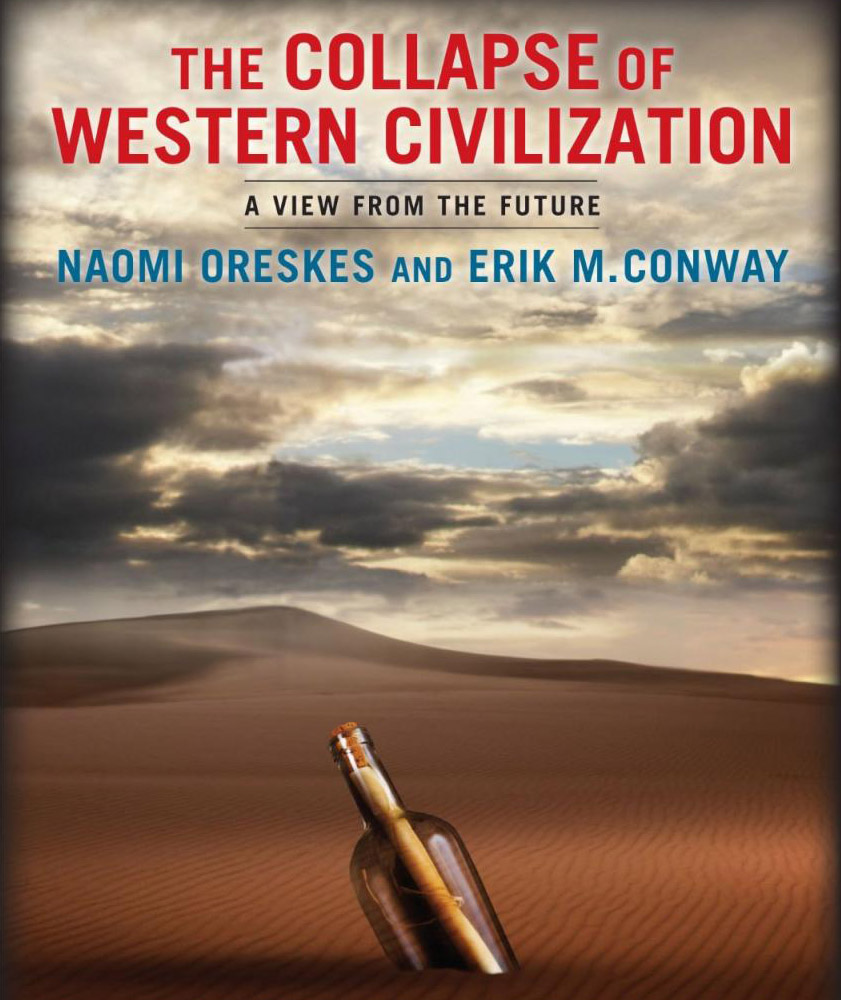
So having just finished a post on climate futures and argued that we should look to climate fiction (cli-fi) for inspiration, last week I read the excellent fictional future history, The Collapse of Western Civilization: A View from the Future, by Naomi Oreskes and Erik Conway. Both authors are probably well known to readers for their outstanding 2010 non-fiction treatise on the history of climate change denial, Merchants of Doubt, which explored how a number of contrarian scientists served the interest of tobacco companies and later the fossil fuel industry in promoting public skepticism and denial over the dangers of their sponsors’ products.

Continue reading Book review: The collapse of western civilization

Regional warlordism versus the digital panopticon

Visitors to this blog will know of my interest in climate futures, a subject I’ve published on in academic outlets. Recently I re-read British sociologist John Urry’s excellent article “Climate Change, Travel and Complex Futures”. I remember first reading this in 2008 and the future scenarios it outlined opened my eyes to the huge issue of climate change adaptation. Indeed, this article and Al Gore’s 2006 movie Inconvenient Truth were major influences in re-directing my research towards the issue of business responses to climate change (which this blog summarizes).

Continue reading Regional warlordism versus the digital panopticon

Studying the Human Implications of Climate Change