This forum launched the initiative ‘Science Based Targets‘ – which aims to encourage businesses to set new, ambitious greenhouse gas emission reduction targets in the run up to the COP21 talks in Paris later this year. Formed as a response to the urgent call by the Intergovernmental Panel on Climate Change (IPCC) to decarbonise the economy, the initiative adopts a scientific approach to climate action in line with the latest IPCC report, and highlights the central role that business must play in responding to the climate threat by reducing GHG emissions in line with the best climate science. Continue reading Road to Paris and Science Based Targets Initiatives→
Published in Mercury Magazine 2014, Summer/Autumn (Special Issue on Sustainability), Issue 7-8, pp. 042-049. Artwork by Bojan Jevtić.
As any student of economic history knows, the notion of destruction has been a grim constant in attempts to characterize the relationship between capitalist dynamism and ever-spiralling consumption. Marx and Engels warned of enforced destruction. Joseph Schumpeter championed a dauntless culture of creative destruction. And now we find ourselves in an era of what we might call creative self-destruction.
The declining diversity of our biological systems has been an on-going feature of human history. As we have developed ever more ingenious and efficient technologies to harness and exploit the natural world, so our impact on nature’s bounty has been crushing. One of the most emblematic examples of this process for me was reading Mark Kurlansky’s marvellous history Cod: A Biography of the Fish That Changed the World. Once a bountiful species (so great in number that John Cabot famously proclaimed in the 1490s that men could walk across the backs of cod on the Grand Banks), Atlantic cod were by the 1990s decimated through the introduction of industrial fishing techniques. Indeed, recent human history is littered with similar examples of species decline and extinction as a result of our industry. Reading Elizabeth Kolbert’s recent book The Sixth Extinction, one of the most tragic is the story of the last great auk; powerful flightless birds that were hunted to extinction in the nineteenth century; the last breeding couple killed in an island off Iceland one June evening in 1844.
As part of the Sydney Southeast Asia Centre ASEAN Forum to commemorate 40 years of Australian engagement with the Association of Southeast Asian Nations (ASEAN), on Thursday September 11th, Sydney Ideas will be presenting a public event focusing on issues of sustainability in Southeast Asia .
We find ourselves in an era of what we might call creative self-destruction. We’re destroying ourselves – it’s as simple as that.
Economic growth and exploiting nature’s resources have long gone hand-in-hand, but as repeated warnings from scientists and reports such as the latest from the IPCC tell us, they now constitute the most ill-fated of bedfellows. Climate change, the greatest threat of our time, is perhaps the definitive manifestation of the well-worn links between economic progress and devastation.
So it has come to this. Despite a mountain of scientific evidence emphasising the catastrophic implications of human-induced climate change, governments seem unable to take any significant steps to break humanity’s addiction to fossil fuels. As Chris Hayes recently noted, having been confronted with the fact of our addiction we now are in the full throws of denial; ‘it’s not that bad’, ‘we need fossil fuels to prosper and grow’, ‘one more fossil fuel development won’t matter’, ‘how bad can it be?’ etc. For governments and politicians long inculcated in the interests of the market and short-term corporate profit, the maintenance of a habitable atmosphere now appears something we are willing to forgo.
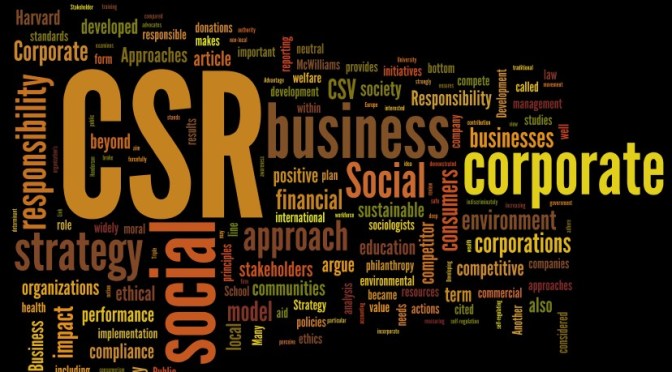
Nearly a decade ago, The Economist ran a special report on corporate social responsibility (CSR) which opened with the line: ‘CSR has won the battle of ideas’. What was true back then in 2005 is certainly a truism today. Hardly any major company does not tell you on their website, their reports or other communications what they are doing with regard to CSR (or whichever other label they choose for this).
As the evidence of climate change mounts, Professor Gail Whiteman says managers must reimagine business. (Text Bennett Voyles)
For some time now, most businesses have put environmental sustainability on an ever-growing list of laudable corporate social responsibility goals. Some have even made serious efforts to achieve that aim.
In researching the practice of corporate sustainability, many of the people I interview highlight the problem of trying to promote and live in a more sustainable way. Here, they stress how trying to take public transport, reduce your carbon footprint, choose renewable power, or build a sustainable home, seem to be increasingly difficult and costly, as if our entire economic system is biased against sustainable options. As one manager put it ‘I feel like I’m working upstream all the time.’
‘Sustainability’ has become a pervasive part of social and business discourse. However getting down to specifics on sustainability is a much debated issue.
This is of particular relevance for climate change. In particular, how can we speak of, or imagine ‘sustainability’, given the underlying conflict that emerges between the pursuit of ‘economic progress’ defined in terms of the production and consumption of goods and services, and the ever escalating production of greenhouse gas emissions.







 Climate, People & Organizations