This short piece profiling my research appeared in the Australian Financial Review BOSS magazine in February last year:
Image: Louise Kennerley
I’m leading a research project examining how Australian businesses are responding to climate change. We’re focusing on how corporations are changing in response to regulatory, reputational and physical risks. These adjustments include new products and services, the measurement and reduction of emissions, pricing of carbon risk in investments and developing green organisational cultures. These are fundamental shifts.
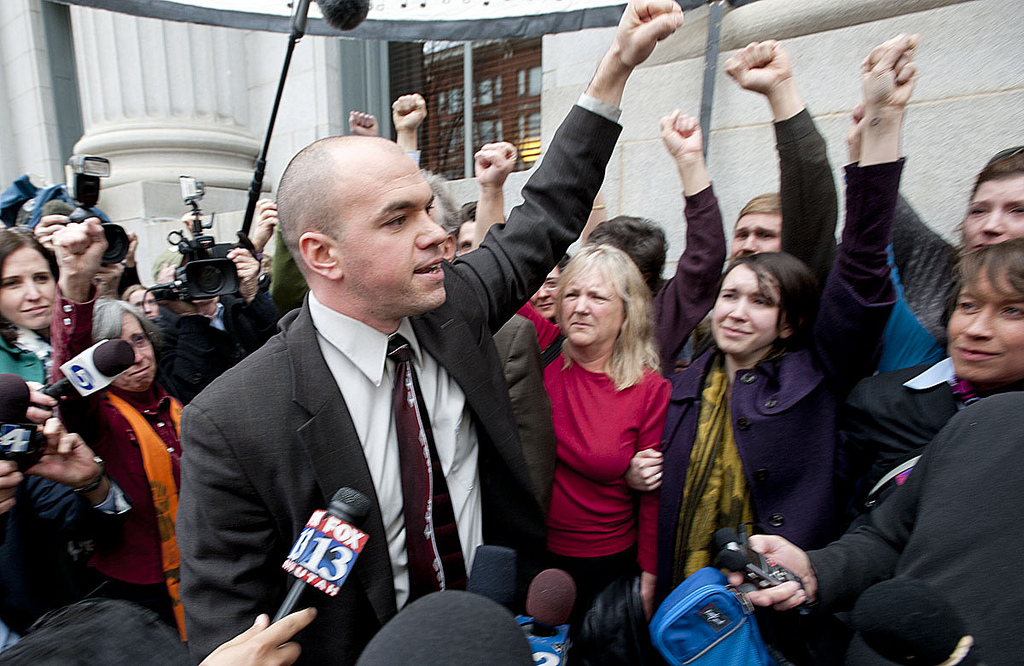
Tim DeChristopher thanks his supporters outside the courthouse where he was found guilty of two felonies for disrupting a Utah BLM oil and gas lease auction in 2009. (Image: Ed Kosmicki)
In the last few weeks there have been a number of commentaries on the shifting nature of climate change activism. These include:
the Sierra Club’s announcement that it will for the first time in its history engage in civil disobedience in the fight against the Keystone XL pipeline;
an article in The Pheonix by Wen Stephenson profiling climate activist Tim DeChristopher and drawing parallels with the nineteenth century abolitionist movement against slavery; and
a recent piece by Andrew Winston in The Guardian pointing to the same theme of a new abolitionist movement around climate change action (you can nominate your favourite ‘climate change abolitionist’ here).
Andrew is the Holcim (US) Professor of Sustainable Enterprise at the University of Michigan. Within this role, he also serves as Director of the Frederick A. and Barbara M. Erb Institute for Global Sustainable Enterprise.
Professor Hoffman has written extensively about corporate responses to climate change; how the interconnected networks of NGOs and corporations influence change processes; and the underlying cultural values that are engaged when these barriers are overcome. His research uses a sociological perspective to understand the cultural and institutional aspects of environmental issues for organizations.
While the media increasingly ignores climate change as a topic (even in the case of scientific evidence linking extreme weather events with climate change), there are good grounds for hypothesising that our personal experience of weather affects our awareness of climate change.
Climate change stirs strong emotions in our work and personal lives (Image: iStockPhoto)
Ever wondered why climate change stirs such strong emotions?
Despite the daily reminders of the politically partisan sub-text of much climate change discussion, this issue hit me up front and personal about a year ago.
I was at a friend’s BBQ in suburban Sydney on a sunny Saturday afternoon, when an acquaintance casually asked what I was working on. Without giving it much thought I replied ‘how businesses respond to climate change’… Stunned silence…A look of bemusement crossed my inquisitor’s face before her partner waded in with the retort, ‘You don’t believe that crap do you?’




 Climate, People & Organizations