
Hans Baer from the University of Melbourne has just published a review essay covering eight of the most recent books examining climate change and capitalism. The essay includes a review of our most recent book Organising Responses to Climate Change. The following is an extract from that review essay which can be found in full in the latest issue of the Journal of Australian Political Economy.
Organising Responses to Climate Change by Daniel Nyberg, Christopher Wright, and Vanessa Bowden (2023), all Australian academics, is a new book that engages with all three themes in this review essay.
Part I of the book, comprising two chapters, touches upon the politics of climate change and states that anthropogenic climate change constitutes the ‘most pressing issue facing human species’ (p. 3). The authors assert that global capitalism, which ‘relies on continued economic growth and fossil fuel consumption’ (p. 4), is the overall driver of the climate crisis, a position previously taken by various radical scholars (Koch 2012, Klein 2014, Weston 2014, Baer 2021). Importantly, the authors identify the key actors in the link between capitalism and climate change, namely multinational corporations, state-owned enterprises, allied governments and political parties, and supporting institutions such as think tanks and the mass media. They say that the ‘COVID-19 pandemic had toppled many of the assumptions of the global economy during the preceding two years’ (p. 5), albeit only briefly, but governments around the world continue to finance fossil fuel projects, a process that has been intensifying a result of Russian invasion of Ukraine. Ironically, of the largest contingent of delegates at the 26th Conference of the Parties (COP) held in Glasgow in November was from the fossil fuel sector. While many governments and corporations in recent years have made ill-defined commitments to carbon neutrality or achieving net zero emissions by 2050, the authors observe that capitalism continues to be addicted to fossil fuels in its drive for economic growth.
Continuing this theme, the authors maintain that the concept of fossil fuel hegemony ‘explains the historical process of political strategies leading to the long-standing impasse on climate change’ (p. 24). Drawing on Laclau and Mouffe’s (1985) reworking of Gramsci’s notion of hegemony, they argue that difference permits hegemonic projects to ‘connect heterogenic demands and interests in continuously changing formations’ (p. 28). In essence, the fossil fuel industry encompasses a wide array of rival companies that compete; with some of them, such as BP, engaging in renewable energy projects, albeit to a limited extent. In their framing of a commitment to achieving net-zero emissions by 2050, Nyberg, Wright, and Bowdon astutely observe that the prevailing corporate and government responses to the climate crisis prioritise ‘time over place’, thus in essence privileging the ‘rights of those living today over those of generations still to come’ (p. 37) and valuing the ‘wealth of Global North over the well-being of populations in Global South’ (p. 37).
In Part II of the book (‘The Politics of Climate Mitigation’), the authors assert that decarbonisation ‘will necessitate the reduction of emissions not only in energy production, but also in transportation, manufacturing, industrial processes, agriculture and food production’ (p. 42), along with terminating ‘deforestation and the destruction of other critical carbon sinks’ (p. 42) at a rapid speed. Instead, they argue that fossil fuel corporations have attempted to shape public opinion so that they are seen as responsible global citizens; slick marketing and advertising campaigns highlight the purported ‘benefits they provide impoverished and marginal communities’ (46). Around the globe, including in Australia, the fossil fuel industry and governments have sought to identify a shift from coal to gas extraction as a transitional emissions mitigation strategy. Also, while corporations of different types have come to recognise that climate impacts will impact their operations, many of them have the option of relocation.
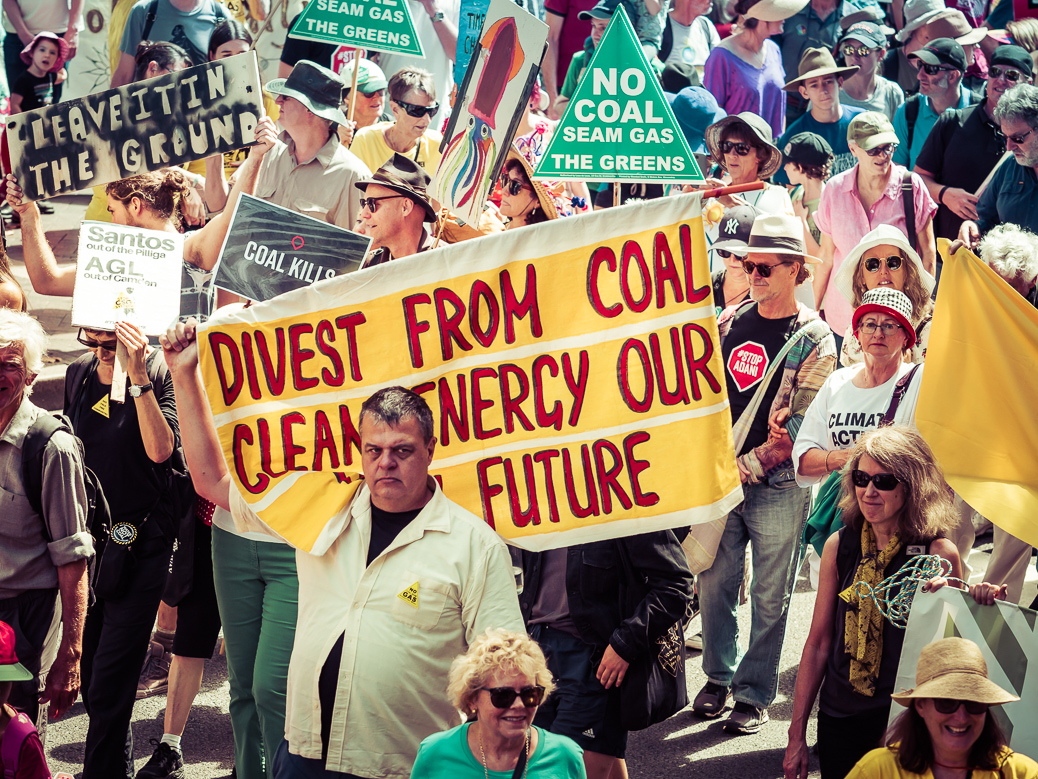
Operating at the margins of climate politics, one finds a disparate climate movement that has existed globally since around 1989 (Camilleri and Falk 2010: 309). Nyberg, Wright, and Bowden argue that a second wave of the climate movement emerged in the wake of the 2015 COP Paris Agreement that sought to limit global warming to two degrees, preferably 1.5 degrees. Given the limitations of the Paris Agreement, it joined old stand-by actors, such as 350.org and the World Wildlife Fund (WWF). The authors identify Extinction Rebellion and Fridays for Future as challenging the ‘everyday – an ineffective – politics of climate change’ (p. 76), thus in essence ‘reconstructing what is seen as the “middle ground” of climate politics by developing the radical flank’ (p. 76). Indeed, while both of these groups were highly effective in mobilising climate protests around the world, at least prior to the COVID 19 pandemic, they have tended to be rather vague in challenging capitalism directly, in contrast to earlier ‘direct action’ groups ‘such the Climate Camps in Europe, Australia and New Zealand, anti-airline protesters such as Plane Stupid; the Keystone XL pipeline blockades in the US and the German anti-coal movement Ende Gelaende’ that preceded them (p. 74). Unfortunately, Nyberg, Wright, and Bowdon fail to make a distinction between the climate movement that is focused on ecological modernisation, particularly replacing fossil fuels with renewable energy sources, and a smaller climate justice movement that calls for ‘system change, not climate change’, and which includes eco-socialists and eco-anarchists within its ranks (Baer 2021: 166-94).
In Part III of their book (‘The politics of climate adaption’), Nyberg, Wright and Bowden argue that corporations continue to exert an ‘outsized influence on the critical decisions society will make about how to best to address the challenges of increasingly hot, unstable and inhospitable planet’ (p. 88). They maintain that corporations function as the ‘key actors in how climate adaptation is framed and enacted’ (p. 95), a process facilitated by governments and the mass media. Their litany of corporate-friendly variants of adaptation includes the focus of engineering and consultancy industries in ‘building greater resilience in the world’s biggest cities’ (p. 101) and various forms of disaster capitalism. It also includes oil and gas companies’ activities in the Arctic, Russia’s positive framing of global warming as a means for opening the Siberian tundra for agricultural expansion, geo-engineering, and the ‘space race’ of Jeff Bezos and Elon Musk, two billionaires who – along with Bill Gates – have expressed their respective commitments to climate adaptation.
Nyberg, Wright and Bowden say that, whereas vulnerable communities are experiencing the impact of an ‘ecological unravelling’ (p. 109) in the form of intense storms, floods, hurricanes, wildfire, and droughts, the mass media tends to downplay the underlying role of climate change in its reportage of extreme weather events. They maintain that the ‘localised nature of adaptation initiatives’ leaves these communities ‘susceptible to a lack of resources, potential corruption, short-term preferences, and other structural constraints’ (p. 116). Whereas NGO civil society has served to expose injustices in their advocacy for the powerless, it has tended to focus on climate mitigation in the Global North and climate adaptation in the Global South.
Part IV of the book (‘The politics of climate suffering’) discusses how corporations have positioned themselves as forces for good in defending themselves against criticisms by NGOs and climate activists. Indeed, some NGOs have been co-opted by such corporate assertions, such as when WWF accepted a $US100 million donation from Amazon founder Jeff Bezos. Nyberg, Wright, and Bowden examine how people adversely impacted by climate change and environmental devastation have challenged their characterisation as powerless victims by ‘making it a potential driver for democratic mobilisation’ (p. 149). Representatives from these communities have even utilised COP events as a platform for stating their case. In doing so, ‘communities at the forefront of climate change impacts have brought to bear in unavoidable ways, the injustices and the implications of the outcomes for all of the fossil fuel hegemony continues unabated’ (p. 157).
Finally, in Part V (‘The politics of climate future’), Nyberg, Wright, and Bowden recognize that ‘simply implementing renewable energy on a large scale does not necessarily break the links between environmental damage and the constructed foundations on which capitalism rests’ (p. 171). They argue that, in contrast to the green capitalist objective of decoupling economic growth from pollution and emissions, ‘degrowth calls for an altogether different kind of economy’ (p. 174). While indeed some degrowth advocates, such as Jason Hickel (2020), make a case for a post-capitalist world system, others such as Serge Latouche, a pioneer of the degrowth movement, believe that degrowth is achievable within capitalist parameters (see Foster 2022: 367). Finally, in their call for a deeper democracy or what they term energy democracy, Nyberg, Wright, and Bowdon maintain there is a need for ‘communities’ direct involvement in energy governance and their increased participation in decisions on production and consumption’ (p. 179).
As the authors observe, while the COVID-19 pandemic provided corporations and governments with an opportunity to ‘push back against global climate activism’ (p. 183), there are signs that it is being reactivated, although slowly. They delineate three trajectories that have emerged recently that reframe and grapple with the climate crisis, namely what theyterm transformismo, Caesarism, and scission. Following Gramsci, transformismo entails incorporation of the population into a hegemonic regime, thus at least in Western societies constructing an ‘equivalence between a more “sustainable” growth economy and individual consumption’ (p. 186). In this process, corporations and governments try to convince people that ‘clean coal’ and natural gas serve as devices to reduce emissions while maintaining fossil fuel hegemony. Following Gramsci again, Caesarism refers to emergence of a great man who presents himself as offering solutions to an uncertain situation. Thus, like Mussolini, figures such as Donald Trump, Xi Jinping, Vladamir Putin, and Jair Bolsonaro are regarded by their supporters as the solution of the failings of democracy. The authors argue that, although ‘corporate leaders have generally been careful in their public endorsement of such populist leaders, the fact is that many traditional industries have benefitted greatly from the diminishing of environmental protections and the rejection of any form of emissions rejection’ (p. 188). Whereas transformismo and Caesarism are hegemonic processes, scission is a counter-hegemonic process such as manifested in the climate movement forming solidarity with the victims of the climate crisis, not only in the Global South but also in the Global North. Nyberg, Wright, and Bowdon argue that bodies such as left-wing government of Kerala, the Left-Green Movement in Iceland, and other regional entities ‘seek to connect climate politics with democratic struggles and aim to interlink on a global level to cooperatively negotiate and create climate democracy’ (p. 191). Of the three scenarios, the authors admit that it is difficult to say which will prevail over the long term, although their preference is for scission.
Conclusion
The eight books reviewed in this essay pose the challenge of determining how we can collectively address monumental political economic, social structural, demographic and ecological problems, while securing a healthy global community, made harder by the on-going COVID-19 pandemic. All these concerns require a safe climate. It is become clearer that capitalism is the overarching driver of climate change as well the larger socio-ecological crisis. In the short run, humanity faces climate dystopian scenarios, given that the various measures to mitigate climate change, ranging from COP declarations to carbon pricing and techno-fixes, are not being successful in significantly reducing emissions. Although ecological modernisation and green capitalism presently constitute hegemonic mitigation agendas, more scholars and activists are envisioning radical climate future scenarios.
The creation of a healthy planet for humanity, non-human and plant life, and planetary ecosystems will require long-term transcendence of the existing capitalist world system and a movement towards a more equitable and ecologically responsible global order. Emergence of such a mitigation strategy is dependent on a vision for an alternative to the present global capitalist world order. Proposals such as global democracy and eco-socialism constitute long-term steps in the creation of a better world for both humanity and the health of its inhabitants and the planet. The application of these radical transitional reforms will require adaption to the varied political, economic, and sociocultural traditions and ecological conditions in both developed and developing societies.
Hans A. Baer is Principal Honorary Research Fellow in the School of Social Political Sciences at the University of Melbourne. hbaer@unimelb.edu.au.
References
Baer, H.A. (2021) Global Capitalism and Climate Change: The Need for an Alternative World System, Lexington Books, Lanham, MD.
Camilleri, J. and J. Falk. (2010) Worlds in Transition: Evolving Governance across a Stressed Planet, Edward Elgar, Cheltenham.
Foster, J.B. (2022) Capitalism in the Anthropocene: Ecological Ruin or Ecological Revolution, Monthly Review Press, New York.
Hickel, J. (2020) Thinking Like a Climate: Governing a City in Times of Environmental Change, William Heinemann, London.
Klein, N. (2014) This Changes Everything: Capitalism vs. the Climate, Allen Lane, London.
Koch, M. (2012) Capitalism and Climate Change: Theoretical Discussion, Historical Development and Policy Responses, Palgrave Macmillan, NewYork.
Laclau, E. and Moufee, C. (1985) Hegemony and Socialist Strategy: Towards a Radical Democratic Politics, Verso, London.
Weston, D. (2014) The Political Economy of Global Warming: The Terminal Crisis. Routledge, London.
 Climate, People & Organizations